Huntsville Tree Removal Pros has handled tree removal in Arab, Alabama for more than twenty years, and this is one of the few cities on our map where the local rulebook is worth reading before a quote is written. Arab carries sixteen sections of landscape ordinance and a two-page approved plant list, which is a great deal of vegetation law for a city of this size. Almost none of it reaches a finished residential lot, and where that line falls is the first thing worth knowing.
Every estimate we write for an Arab address splits into three priced lines: the takedown, the stump, and the debris. Those are the three numbers competing quotes disagree about, so separating them is the only way a cheap bid and an expensive one can be compared honestly. Haul-away is stated on the same page in words, included or not included, and rounds left cut and stacked come back as a firewood credit on that estimate.
Access gets measured before the tree is priced: gate width, drop zone, carry distance to the truck, and where a chipper that will never fit through a back gate is going to sit instead. On a fenced back yard that answer decides the method before the tree does.
No permit for a tree in your own yard, and a fee schedule that proves it
The governing document is the Zoning Ordinance of the City of Arab, Ordinance 2016-3, adopted April 4, 2016 and updated by Ordinance 2025-11 on October 20, 2025. Its Article V, Landscape and Buffer Requirements, runs from Section 500 through Section 515 and closes with a two-page approved plant material list at Table 5-1. The article opens by saying it exists to preserve, protect and maintain healthy existing vegetation and to hold a sustainable amount of canopy on public and private land in the city.
What matters to a homeowner is the scope clause. Section 502 applies the article to site and land development projects and development activities within the corporate limits, including the development of subdivisions but expressly not individual lots within subdivisions. Section 503 narrows it again, to new construction, redevelopment or change of use for multifamily residential, commercial or industrial property.
A dying oak in a back yard on a recorded lot is outside both of those, and we do not rest that answer on the absence of a rule. The Building Department’s published fee schedule lists building permits by construction value and then names every other permit it issues, including sign, pool, moving at 100 dollars and demolition at 100 dollars. There is no tree, vegetation, land-disturbance, grading or clearing permit anywhere on it, and a permit that existed would carry a fee.
The one city rule that reaches a standing yard tree
Section 424 is the exception worth knowing, and it is not a permit. Inside the triangular clear-vision area at a street intersection, nothing may be erected, planted, placed or allowed to grow so as materially to impede vision between two and a half feet and ten feet above the grade at the intersection of the street center lines. A corner-lot tree or hedge can fall out of compliance simply by growing, which makes it a standing trimming obligation rather than a removal question.
Looking for tree-removal closer to Redstone Arsenal? See Tree-Removal in Redstone Arsenal.
What Article V does bind, and how tightly it binds it
Turn the same article toward a development site and it gets strict quickly. Under Section 505 a landscape plan must be submitted to and approved by the Planning Commission or their designee before a Land Development Permit or a Building Permit is issued, and the plan has to be certified by the architect, landscape architect, engineer, surveyor of record, horticulture professional or landscape contractor of record. The planting schedule has to name every plant by botanical name, common name, cultivar, quantity, size at planting and spacing, along with any existing trees approved for use.
Section 511 is where the article grows teeth. No certificate of occupancy issues for a new development that has not met its requirements or an approved landscaping plan, and the site is inspected first. Where circumstances make planting impossible, the administrator can release the certificate only after the owner posts a completion bond or certified check equal to 125 percent of the remaining landscaping cost including labor, with installation finished no later than six months after the certificate is issued.
Clearing the lot early is itself the offense
Section 417 catches the crew that arrives before the paperwork does, because site alterations, re-grading, filling and clearing or planting vegetation prior to approval of the plans for development is a violation of the ordinance in its own right. The same section caps disturbance on steep ground, allowing no more than 15 percent of an area with slopes of 33 percent or greater to be developed, re-graded or stripped of vegetation, and no more than 5 percent where the soils are erosion-prone as defined by the Natural Resources Conservation Service. Perennial streams keep a 50-foot undisturbed strip from the top of bank on either side unless the City Engineer permits otherwise.
Enforcement sits in Section 515: a violator gets written notice and 15 days to correct, after which each day counts as a separate offense punishable by the maximum fine the City Council has set. Questions about any of it go to the Planning and Zoning office at City Hall on North Main Street, where Kim Johnson is Zoning Administrator. Section 416 is worth remembering out toward the edge of town, because it pushes city standards into a three-mile planning jurisdiction beyond the corporate limits.
Section 513 names the tree contractor, not just the owner
Most municipal tree rules speak only to property owners. Section 513 does not: in the case of any canopy tree removed or otherwise destroyed by the willful act of the property owner, tenant or contractor, a tree of the same or larger caliper must be used as a replacement. Where replacement at the same or larger caliper is not feasible, the Planning Commission or their designee may set alternative replacement criteria.
That sentence is why we ask for the approved landscape plan before the saw comes off the truck on any commercial, multifamily or newly developed site here. A canopy tree standing in a required landscape area may be a credited tree under Section 506, which lets a preserved healthy tree of an approved species count toward the planting requirement, and a credited tree carries the same maintenance and replacement duty as one that was planted. Removing it without that check hands the owner an obligation nobody priced.
Caliper, root zone and diameter at breast height, as this city defines them
Arab writes its own definitions in Section 504, and a replacement argument gets settled on those rather than on general practice. Caliper is measured six inches above the ground for trees up to and including four-inch caliper size, and 12 inches above the ground for larger sizes. Diameter at breast height is the diameter four and one half feet above ground level, and the critical root zone is the area on the ground within the tree’s drip line.
Working inside a protected root zone
Section 510 governs what happens around a preserved tree during construction. Its critical root zone has to be fenced and protected from compaction, trenching, harmful grade changes and other injury, and shown that way on the approved landscape plan. Pavement, building foundations and other impervious surfaces may not encroach into that zone unless preservation practices are followed that keep oxygen, water and nutrients moving to the root system, so air excavation at the root collar and hand digging are what we bring inside the fence.
Plateau ground, grinding depth, and where the wood goes
Arab sits on Brindlee Mountain, an isolated portion of the Appalachian Plateau in northern Alabama rather than a piece of the valley floor below it. The mountain is a sandstone cap-rock over limestone, with a shale layer 75 to 100 feet under the summit that has cut bluffs on all sides, and the city itself stands at roughly 1,040 feet. That places it in ecoregion 68d, the Southern Table Plateaus, inside Level III ecoregion 68, the Southwestern Appalachians, which is a different Level III region from the limestone valley and carries different soil, different parent rock and a different forest.
Why we will not quote a grinding depth over the phone
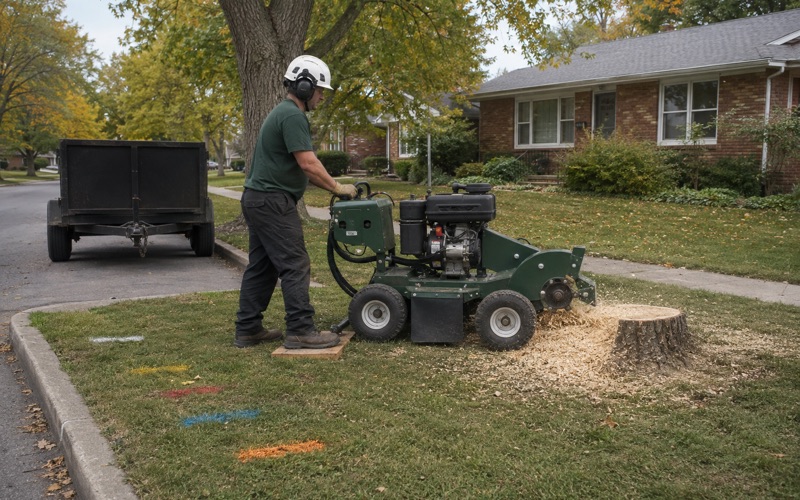
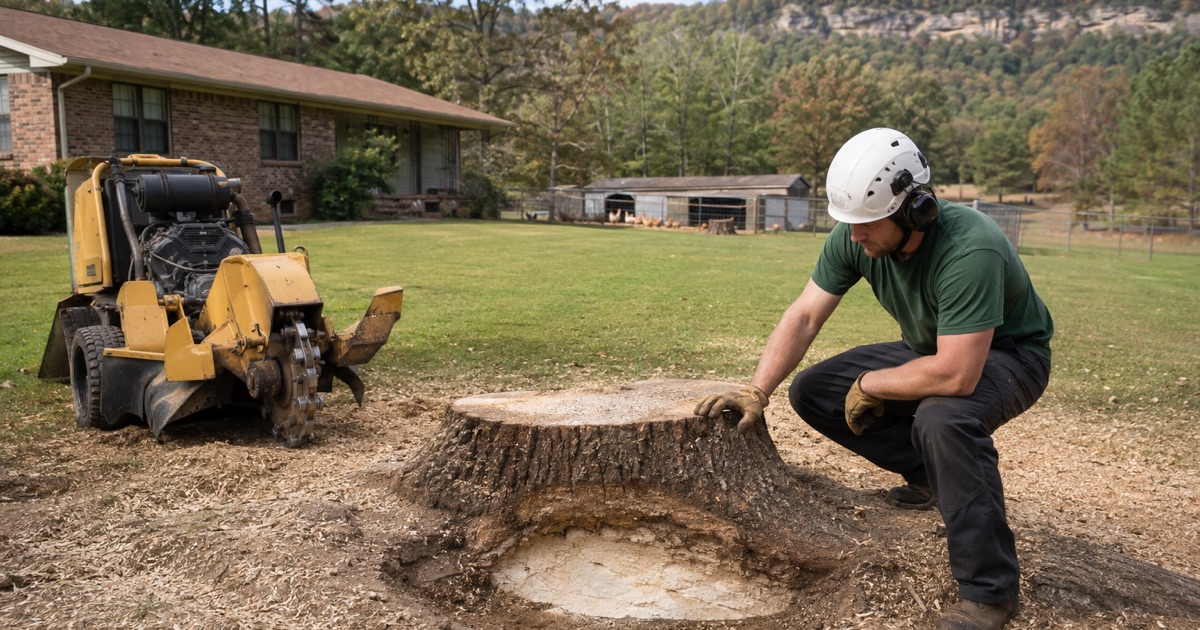
The Hartsells soil series, whose type location is in Marshall County, is moderately deep and well drained, formed in loamy residuum weathered from acid sandstone, with depth to bedrock and solum thickness ranging from 20 to 40 inches. The Albertville series, one of its geographic neighbors on this plateau, formed instead in clayey residuum weathered mainly from shale, with solum thickness and depth to soft shale of 40 to 60 inches. A stump grinder rated to cut roughly 12 to 25 inches below grade will meet sandstone before it meets the bottom of the root plate on the shallow end of that first range, while on the deeper profile the machine’s own stop binds first.
Two lots on the same street can answer that question differently, and no point-level soil query has been run for any address here, so we will not tell you which series is under your yard. What we do instead is price the takedown, then set a grinding depth once the stump is open and the carbide teeth have reported what is under it. The same shallow rooting explains the failure pattern on this ground, because a root plate that spreads wide instead of deep is what lays a whole tree over in saturated conditions rather than breaking a trunk.
Debris is a priced line here for a reason
The city Street Department runs a brush route on a rotating weekly schedule and collects solid waste goods one time per month, and its own policy says brush pick-up does not include contractor jobs, per city ordinance. Material left at the curb after a contractor job is removed and billed on the property’s water account on an escalating scale, with the first load included, a second at 100 dollars and a third at 200 dollars. The city landfill out on Hog Jaw Road is classified as a construction and demolition site under ADEM Permit 48-03, takes cash only, charges a 20 dollar minimum under 1,000 pounds and 50 dollars per ton above that, and accepts only loads originating inside the city limits or the Arab police jurisdiction.
Arab Electric Cooperative, which trims for line clearance out at the road and asks members to keep meters and service poles clear, states plainly that disposing of the limbs cut from a member’s trees is the landowner’s responsibility. None of that adds up to an easy place to put a yard’s worth of green wood, which is why haul-away appears on our estimate as a line with a number rather than an assumption. If you would rather keep the wood, we say so on the same page and credit it there.
- 20+ Years in the Valley
- Free Written Estimates
- Same-Day Storm Calls