
Huntsville Tree Removal Pros has been grinding stumps in Huntsville, AL for more than twenty years, serving surrounding cities including Redstone Arsenal, Madison, Triana, Harvest and Meridianville. Stump grinding is quoted here as its own priced line rather than as an assumed extra, with the depth below grade, the fate of the grindings and the treatment of the lateral roots all written down before a machine is unloaded.
That matters more in this trade than it sounds. The single most common complaint about tree work in this market is a stump left in a lawn after a takedown somebody thought was complete, and it happens because a lump-sum bid never said either way. Ours says. The estimate carries the takedown, the stump and the debris as three lines that can each be taken or declined.
Twenty years on both of this city’s forests is what makes the depth number honest. On the limestone valley floor the soil above bedrock is deep residuum, so it is the machine that stops, not the ground. Up on the escarpment shoulders and the plateau that reverses, and a promise of a foot below grade written from a valley job does not survive contact with a Monte Sano lot.
Grinding or Excavation, and What Each One Leaves
Grinding: Chips, a Cone, and the Root Plate Still in Place
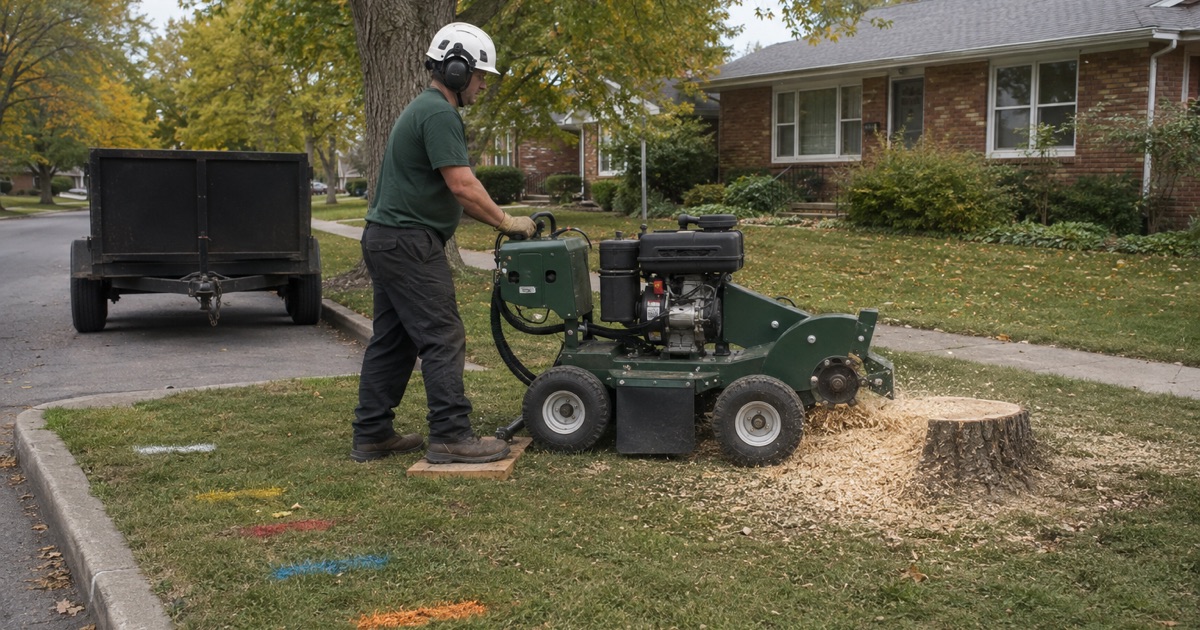
A grinder turns the stump and the collar around it into chips, working a cone down below grade while the root plate and the lateral roots stay where they are. It is fast, it needs far less machine than digging, and it leaves the surrounding lawn largely intact. For the overwhelming majority of residential stumps it is the correct answer and the cheaper one.
Full Excavation and the Hole It Makes
Digging the stump out takes the root plate with it and leaves an open hole that has to be backfilled, compacted and settled, usually with imported soil and a follow-up visit once it slumps. It needs an excavator with room to swing and a route to get there. It costs more, disturbs more, and is worth it in a narrow set of cases rather than as a default.
When a Slab, a Pool or a Trench Forces the Issue
The decision stops being about preference when something structural is going over the spot. A footing, a pool shell, a driveway pour or a utility trench cannot sit above decomposing wood, because the wood keeps shrinking for years and the surface follows it down. Where that is the plan, the plate comes out; where the plan is grass, grinding is enough and the difference is real money.
Grinding Depth, Machine Class and Huntsville Soils
Cutting Wheel, Carbide Teeth and Reach Under the Collar
Depth below grade is a geometry problem. The cutting wheel’s diameter, the carbide tooth pattern and how far the wheel can swing beneath the root collar set the maximum, and machine class is what varies those. A walk-behind that fits a thirty-inch gate reaches a few inches; a tracked machine with room to work reaches a foot or more. We name the achievable depth for the machine that can actually get there.
Deep Limestone Residuum on the Valley Floor
On the valley floor around Huntsville, the weathered material above the limestone runs deep, so a grinder working a residential stump is stopped by its own reach rather than by rock. That is the ordinary case here and it is why depth promises can be kept on most lots in this city. It also means a bid that blames shallow rock for a shallow grind on the valley floor is describing the machine, not the ground.
Escarpment Shoulders, Plateau Lots and Real Rock
The picture changes on the slopes of Monte Sano and Green Mountain and out on the plateau, where soil over rock is genuinely thinner and a machine can find stone before it finds its own limit. Karst features complicate it further, since solution channels and voids do not distribute evenly. Those lots get a depth stated as a target with the condition named, rather than a flat number that may not be reachable.
Access: Getting the Machine to the Stump
Gate Width, Back Yards and Narrow-Access Machines
The stump is rarely the constraint. Gate width, a step down off a patio, a raised bed or a shed in the wrong place decide which machine can reach the work, and a fenced back yard in Hazel Green or New Market frequently rules out anything with real cutting capacity. We measure the gate and the route before pricing, so the depth quoted belongs to a machine that can physically stand at the stump.
Slopes, Retaining Walls and Where the Machine Sits
A grinder works by sweeping a spinning wheel sideways, which puts load through the tracks and into whatever they are parked on. On a sloped yard, above a segmental retaining wall or beside a septic field, where the machine sits is a decision rather than an afterthought. Getting that wrong damages something far more expensive than the stump was.
Locates, Irrigation and the Lines Nobody Marks
Public utilities get marked through the free locate service before anything runs. Private lines are the exposure: irrigation mains and heads, low-voltage lighting, invisible fence wire and septic laterals are not covered by a public locate and are usually shallow. Walking those with the homeowner takes ten minutes and prevents the one failure on this job that turns a small ticket into a repair.
After the Grind: Grindings, Roots and Restoration
The Crater, and Why the Spot Keeps Sinking
A finished grind leaves a mound of chips over a depression, which reads as a full hole on the day and settles for a year or more as the wood decomposes. Homeowners who spread the mound flat and seed it usually end up with a dish. The way out is to remove the grindings and backfill with soil, or to expect a second topping-up, and the estimate says which is included.
Surface Roots Grinding Never Touches
Grinding is local to the stump. The lateral roots running out under the lawn stay, and on a mature water oak, silver maple or hackberry they can lift sod and show as ridges for years. That is normal rather than a defect in the work, and it becomes a problem only where sod, a patio or a drive is going down. Removing them is a separate operation, priced separately.
Backfill, Soil and Getting Grass to Take
Wood chips tie up nitrogen while they break down, so grass seeded straight into grindings comes up thin and yellow no matter how it is watered. Where the plan is lawn, the practical route is taking the chips out, filling with topsoil, and seeding or sodding onto that. It is a small line on an estimate and it is the difference between a repaired lawn and a pale circle.
Our Step-by-Step Stump Grinding Process
Step 1: Measure the Stump and the Route In
We measure stump diameter at the flare rather than at the cut, since the flare is what has to be ground, and we measure the access route: gate width, gradients, steps and anything the machine has to cross. That pairing decides machine class, and machine class decides depth.
Step 2: Locate What Is Underground
The public locate is called in, and the private lines are walked with whoever knows the property. Irrigation, lighting, fence wire and septic get flagged. Anything unknown gets probed rather than assumed, because the cost of finding out with the teeth is entirely one-sided.
Step 3: Grind to the Agreed Depth
The wheel works the stump and the flare down to the depth on the estimate, with the operator sweeping in passes rather than pushing, and with chip containment set up where the stump is close to siding, glass or a vehicle. Depth is checked against the surrounding grade before the machine moves off.
Step 4: Finish the Spot the Way the Estimate Says
Grindings are left mounded, spread as mulch, or removed and the hole backfilled with soil, exactly as agreed. Lateral roots come out if that line was taken. The site is raked and blown down, and anything still settling is named so nobody is surprised by a dish in the lawn next spring.
- 20+ Years in the Valley
- Free Written Estimates
- Same-Day Storm Calls