
Huntsville Tree Removal Pros has handled land clearing and forestry mulching around Huntsville, AL for more than twenty years, serving surrounding cities including Redstone Arsenal, Madison, Triana, Harvest and Meridianville. That covers a fence line disappearing into privet, a back acre nobody has walked in fifteen years, a wooded lot going under a house, and commercial ground being opened for a pad.
The decision that drives the price is not acreage. It is what happens to the material and whether the stumps stay. A mulcher that leaves everything on site as a chip layer, a crew that hauls to a gate, and an excavator grubbing root plates out to grade are three different jobs at three different prices, and a quote that gives one number without saying which of them it covers is not comparable to anything.
Two decades in this metro is what makes the site walk worth something. A wooded lot on the limestone valley floor, a slope on the Green Mountain escarpment and an old pasture growing back to cedar and privet each behave differently under a machine, and the four counties this ring crosses do not charge alike at the gate — which is exactly the variable that decides whether hauling or mulching is the cheaper route on your site.
Forestry Mulching, Grubbing and Full Clearing
Forestry Mulching in Place
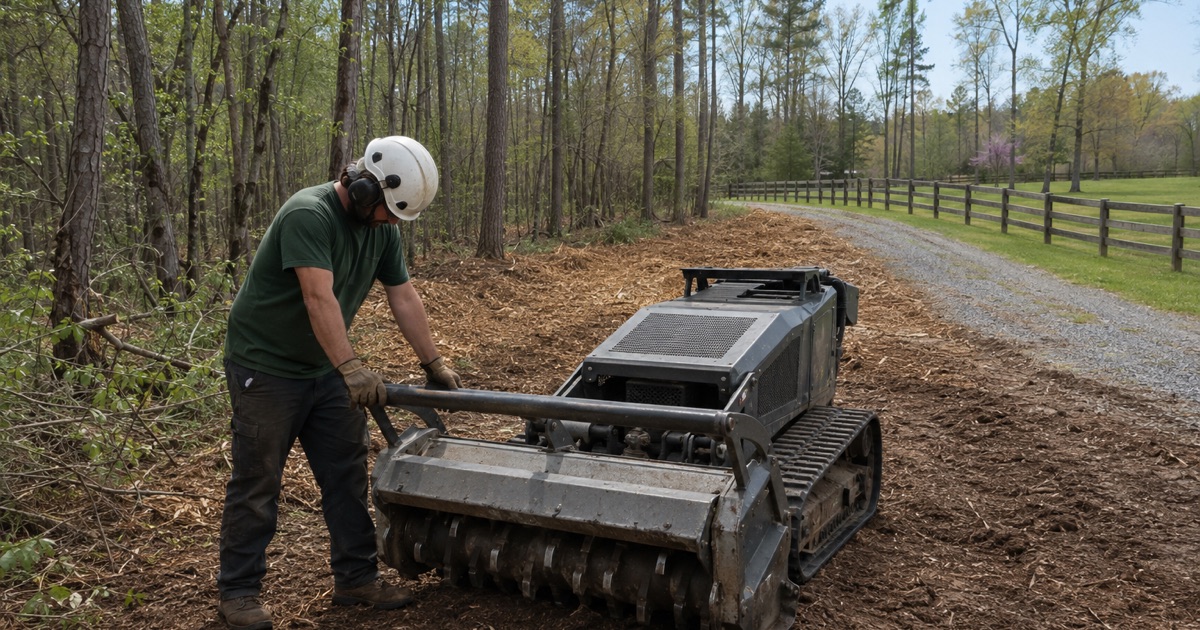
A forestry mulcher grinds standing stems, brush and vines into a mulch layer where they stood, so nothing is piled, burned or trucked. That removes the two largest costs on most clearing jobs at once, and it leaves the soil covered, which matters on any slope that would otherwise start moving after the first rain. It is the right default for understory, regrowth and anything below the machine’s diameter ceiling.
Grubbing Stumps and Root Plates to Grade
Grubbing takes the root systems out with an excavator and brings the ground to a workable grade. It is the expensive half of clearing and it is unavoidable where a slab, a footing, a road or a trench is going in, because organic material left underneath keeps decomposing and the surface above it keeps settling. It is quoted separately from the clearing itself for exactly that reason.
Selective Clearing and the Trees Worth Keeping
Most sites have a few trees worth more standing than the whole job costs, and they get identified before the machine starts rather than mourned afterward. Selective clearing means marking those, protecting the tree protection zone around them for the duration, and routing traffic and spoil outside it. Compaction inside that circle is what kills a preserved tree three years after everyone has moved on.
Commercial and Residential Land Clearing
Build Pads, Subdivisions and Commercial Sites
On a commercial or subdivision site the clearing has a schedule attached and downstream trades waiting on it, so the sequencing matters as much as the machine. Limits of disturbance get marked, erosion controls go in before the ground is opened rather than after an inspection, and the material decision is made early because hauling volume drives truck counts. Huntsville’s research park and industrial corridors have kept us in that work steadily.
Residential Lots, Fence Lines and Back Acreage
Residential clearing is usually a smaller machine and a tighter set of constraints: a septic field somewhere, a well, a neighbor’s fence a few feet off, and no room to stage material. A fence line choked with privet, honeysuckle and volunteer hackberry is the most common version, and it is a mulching job rather than a clearing job because none of it needs to leave the property.
Pasture Reclamation and Invasive Regrowth
Ground that has stopped being mowed goes back to eastern redcedar, privet, sweetgum and blackberry faster in this valley than most owners expect, and by year ten it is a clearing job rather than a bush-hogging job. Mulching resets it in one pass and leaves a layer that suppresses the next flush, though anything with a root system still in the ground will try again and a follow-up season is usually part of the plan.
Boundaries, Runoff and What the Regulators Reach
Land Disturbance, Grading and Erosion Control
Removing a tree from a private lot inside Huntsville needs no city permit, but opening ground is a different regulatory question from cutting a tree. Grading, land disturbance and stormwater are handled at state and county level, with the thresholds turning on how much area is disturbed and where the water goes. We establish who has to file, and what has to be in place before the first pass, as part of quoting.
Boundaries, Right of Way and Marked Corners
We work to located pins, not to fences, because a fence built in 1978 is evidence of nothing. Where a job runs to a property line, the corners get found or a surveyor gets involved first. The right of way along a public road belongs to the city or the county rather than to the adjoining owner, so vegetation inside it is not the landowner’s to clear on their own initiative.
Height Overlays Near the Airport and the Arsenal
Parts of this ring sit under aviation height regulation: Huntsville zoning carries an airport obstruction article, the City of Madison has its own tree-height provision with a fifty-foot safe harbor written into it, and the Redstone military compatibility overlay reaches vertical obstruction across several jurisdictions. On a site inside those areas, what gets cleared and what may be allowed to grow back are both live questions rather than assumptions.
What Happens to the Material
The Mulch Layer Left in Place
Left on site the material costs nothing to dispose of and does useful work: it covers bare soil, slows runoff on a grade and breaks down into organic matter over a few seasons. Thickness is the variable. A heavy layer over ground that has to grow grass next spring is a problem; the same layer on a slope holding until roots take is the reason to do it.
Chips, Burn Piles and Hauling Off
Where material has to leave, it leaves as chips in a truck or as logs on a trailer, and both are priced by volume and distance rather than by wishful thinking. Burning is regulated and is not a default we assume. On mixed jobs the usable wood is separated out, since rounds worth splitting are worth more stacked than they are ground into a mulch layer.
Gate Fees, and Why the County Line Changes the Price
Disposal is the line item that moves most between jobs that otherwise look identical. The counties this ring crosses set very different terms for yard debris, wood and construction material, one of them takes self-loaded yard debris at no charge, and at least one refuses loads originating outside its own jurisdiction entirely. Where the material is going is settled during the estimate, because it is often the difference between two bids.
Our Step-by-Step Land Clearing Process
Step 1: Walk the Site and Define the Limits
We walk the whole area with whoever owns the decisions: what comes out, what stays, where the boundary actually is, and what is going on the ground afterward. That last answer is what determines whether stumps are part of the job, and it is the single largest swing in the price.
Step 2: Locate Utilities, Wells and Septic
Public utilities get located. Wells, septic tanks and fields, buried irrigation, and old farm lines get walked with the owner, because none of those show up on a public locate and all of them are expensive to find with a machine. Anything uncertain is probed or avoided rather than assumed clear.
Step 3: Protect What Stays, Then Clear
Erosion controls and tree protection fencing go in before the ground is opened. Clearing then runs in a planned sequence rather than wherever the machine happens to be pointed, with large stems felled and processed ahead of the mulcher and the preserved trees left with their root zones untouched.
Step 4: Grade, Dispose and Hand Over a Usable Site
Stumps are grubbed if that line was taken, and the ground is left at the agreed finish: mulched, raked, or graded and ready for the next trade. Material leaving the site goes where the estimate said it would go, and what stays is spread to the thickness that was agreed rather than piled where the machine finished.
- 20+ Years in the Valley
- Free Written Estimates
- Same-Day Storm Calls