
Huntsville Tree Removal Pros has been doing tree trimming and pruning in Huntsville, AL for more than twenty years, serving surrounding cities including Redstone Arsenal, Madison, Triana, Harvest and Meridianville. Every estimate names which pruning operation is being bought, because four different jobs get called trimming on the phone and they are not interchangeable in price, in method or in what the tree looks like afterward.
Two decades on the same species in the same valley is what decides the hard calls on this page. Water oak, silver maple, hackberry and Bradford pear dominate the calls here, and all four share a habit of building weak unions that get worse with size. Knowing which of them can be reduced back into a sound structure and which one is simply too far along is not something a price list can tell you.
This page also covers cabling and bracing, because on a large tree that is the real alternative to a removal. Two Huntsville operators already sell support systems by name, so it is an ordinary local option rather than something exotic, and it deserves to be quoted next to the takedown price rather than mentioned after the decision has been made.
The Four Pruning Operations
Crown Cleaning: Dead, Broken and Diseased Wood
Cleaning is the removal of dead, dying, broken and diseased branches, and nothing else. It is the most common job on a mature tree, the safest for the tree, and the one with the clearest payoff, since the wood being removed is what falls into a driveway on a still night. It changes the tree’s silhouette very little, which is exactly the point.
Crown Raising: Clearance Underneath
Raising removes the lowest limbs to create clearance over a roof, a drive, a sidewalk or a sightline. The constraint that gets ignored is how much live crown is left afterward: a tree raised too far carries all its foliage at the top, which raises the center of wind load and looks like a lollipop for the rest of its life. We raise in stages on young trees so the final form is planned rather than discovered.
Crown Reduction and Thinning
Reduction shortens the outer crown back to live lateral branches large enough to assume the lead, which lowers the lever arm on limbs that keep moving in wind. Thinning selectively removes interior branches to open the crown without changing its outline. They solve different problems, and thinning in particular is oversold — an over-thinned crown loses its interior foliage permanently and answers with weak sprouts.
Cabling, Bracing and Buying Years Instead of a Removal
Static and Dynamic Cabling Systems
A cable installed high in the crown limits how far two leaders can move apart in wind. Static systems use steel and hold hard; dynamic systems use synthetic rope with some give, letting the tree keep flexing and building reaction wood while capping the extreme movement. Which one suits a tree depends on how much motion the structure still tolerates, and it is a judgement rather than a catalog choice.
Threaded Steel Bracing Rods Through a Union
Where a union has already begun to split, a cable alone does not address the crack. Threaded steel rods installed through the union hold the two halves together mechanically, usually in combination with a cable further up to reduce the load reaching them. It is invasive, it is permanent, and it is appropriate for a specific defect rather than as a general upgrade.
What a Support System Costs Against a Removal
On a large mature tree the arithmetic is usually not close. A support system with an inspection interval costs a fraction of a crane-assisted takedown plus a stump plus the loss of forty years of shade, and it postpones the decision by years rather than months. We price both on the same estimate so the comparison is made with numbers instead of with an impression of what is safer.
Clearance Over Roofs, Drives and Conductors
Clearance From Structures
Limbs bearing on shingles abrade them every time the wind moves, and a limb overhanging a roof is also the route squirrels and debris take onto it. The correct fix is usually reduction back to a lateral rather than a flush cut at the trunk, because a large removal cut at the stem opens a wound the tree may never close. We aim for clearance that lasts a few seasons rather than a haircut that has to be repeated annually.
Line Clearance by Conductor Voltage
Required clearance from an energized conductor is a function of the voltage on that line, so there is no single distance that answers the question. Work near primary distribution lines belongs to the utility’s line clearance program, which is permitted to cut fast-growing species back harder than slow ones, and Huntsville’s own ordinance carries species language on what may be planted under lines in the first place.
The Wire Between the Pole and the House
The service drop is the exception homeowners are rarely told about. Huntsville Utilities places responsibility for clearing that wire with the customer, while Joe Wheeler EMC will arrange a disconnect so a tree can be worked. Because this ring crosses several utility territories, we confirm which one bills the address before scheduling anything that puts a saw near the drop.
Cuts, Dose and What Not to Do
Why Topping Is Not a Pruning Operation
Topping cuts limbs back to stubs without regard for lateral branches. The tree responds with epicormic sprouts, a dense flush of shoots from dormant buds that are attached only to the outer wood and break easily, while a decay column runs down from every stub. Two springs later the tree is taller, heavier and structurally worse, and the only remaining option is more expensive than the original job.
How Much Live Crown Can Come Off
Every leaf removed is photosynthesis removed, and a mature tree has less capacity to recover from heavy pruning than a young one. Large reductions get staged across seasons rather than done in one visit, and a tree that would need to lose most of its crown to satisfy the request is a tree in the wrong place, which is a conversation worth having honestly rather than working around.
The Cut Itself: Collar, Flare and No Sealant
A correct cut sits just outside the branch collar, leaving the collar intact so the tree can compartmentalize behind it. Flush cuts remove that tissue and produce wounds that stay open for years. Wound paint does not help and can hold moisture against the wood. On the root side, the same principle applies to the root flare, which should never be buried under mulch piled against the trunk.
Our Step-by-Step Tree Pruning Process
Step 1: Establish What the Pruning Is For
Clearance, structure, storm risk, light for a lawn and view are five different objectives that pull in different directions. Naming the objective first is what determines which operation goes on the estimate, and it stops a cleaning job from turning into a reduction because somebody was already up there.
Step 2: Inspect Before Quoting
The tree gets looked at from the ground and, where it matters, from the crown: unions, old wounds, deadwood distribution, the root flare and anything hanging over a target. A tree that turns out to need a support system rather than a haircut is better identified here than after a climber is tied in.
Step 3: Prune to the Named Operation
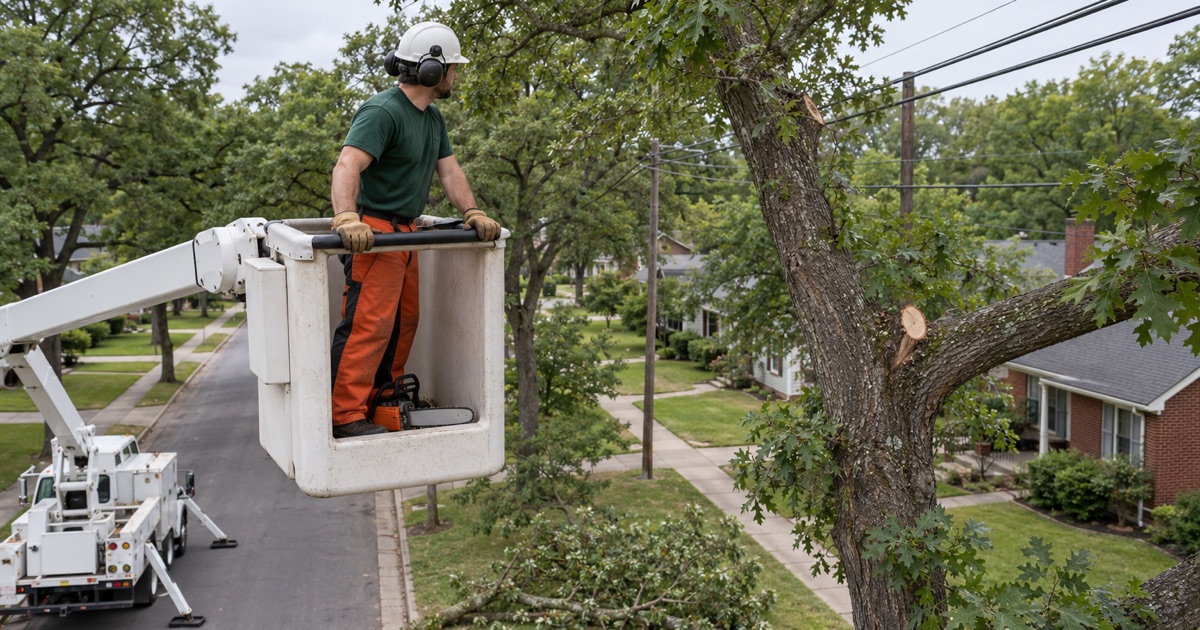
Work is done from a climbing saddle or an aerial lift depending on access, with cuts placed at the collar and larger limbs rigged down rather than dropped where a target sits below. Nothing is taken beyond the scope on the estimate without a conversation first, which is how scope creep in this trade turns into a topped tree.
Step 4: Clean Up and Say What Comes Next
Brush is chipped or hauled per the debris line on the estimate, and the site is raked and blown. Where a support system was installed, the inspection interval is written down. Where the work was staged, the next stage and its rough timing go in writing, so the plan survives longer than anyone’s memory of the visit.
- 20+ Years in the Valley
- Free Written Estimates
- Same-Day Storm Calls