
Huntsville Tree Removal Pros handles shrub, hedge and brush removal across Huntsville, AL alongside the larger tree work, and after twenty years in this valley the pattern is consistent: the shrubs are rarely the hard part. What decides the price is what is underneath them, what grows back, and where the pile goes afterward, and those are the three things most quotes for this work leave unstated.
Brush in particular is where homeowners get caught. Huntsville’s curbside yard-waste program is generous up to a point and then explicitly excludes anything a contractor cut, which is a sentence people usually meet on collection day rather than on an estimate. Ours names the disposal route in words before anyone starts, because a free pickup that turns out not to apply is a real cost that lands after the crew has gone.
We also separate cutting from removing. Taking a shrub off at grade and taking its root system out are different jobs at different prices, and which one is correct depends entirely on what is going over the spot afterward and on whether the species comes back from a stump. Both go on the estimate so the choice is deliberate.
Shrubs, Hedges and Foundation Plantings
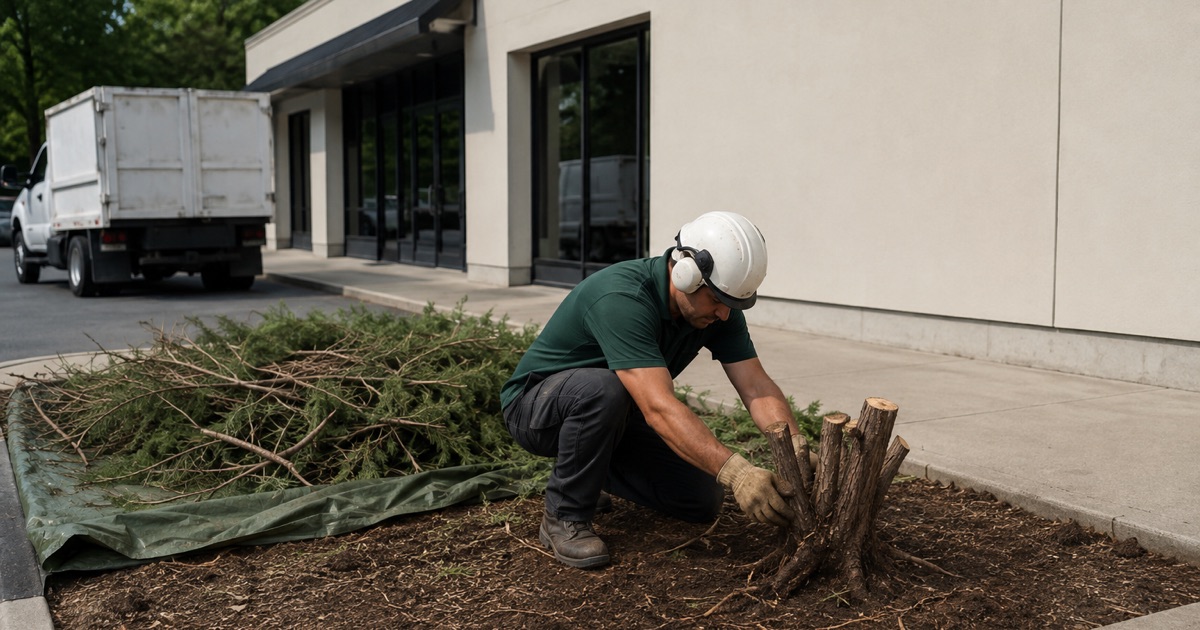
Overgrown Foundation Shrubs, and What Is Behind Them
A row of thirty-year-old hollies or junipers against a house is usually hiding something worth seeing: siding that has stayed damp, a foundation vent packed with leaf litter, a downspout discharging into the bed, or a crawlspace access nobody has opened in a decade. Removal gets planned around irrigation, downspouts and shallow lines rather than driven straight through, and what is found gets pointed out rather than covered back over.
Removing a Hedge Against Renovating One
Not every overgrown hedge needs to come out. Some species tolerate hard renovation pruning and rebuild from old wood over a couple of seasons; others have no latent buds down there and never recover from being cut back into bare stems. Which category a hedge falls into is a species question, and it is worth asking before spending the removal price on something that could have been reclaimed.
Leyland Cypress Screens That Have Outgrown Their Row
Alabama’s own extension figures put a mature Leyland cypress at seventy feet or more with a minimum spacing of fifteen to twenty feet on centers, against the six to eight feet homeowners plant a privacy screen at. Crowded like that, the interiors shade out, Seiridium canker moves down the row, and what was a screen becomes a line of half-dead stems. Removal of the row is a common job here and it is a tree job, not a shrub job.
Brush, Fence Lines and Regrowth
Privet, Honeysuckle and Volunteer Hardwood
Ground that stops being mowed in this valley goes to Chinese privet, Japanese honeysuckle, blackberry and volunteer sweetgum and hackberry faster than most owners expect, with eastern redcedar following behind. By the time it is a call to us it is a stem-diameter problem rather than a mowing problem, and it is cleared with a mulching head or by hand depending on access and what has to be protected.
Fence Lines, Easements and the Actual Boundary
We work to located corners rather than to fences, because a fence is evidence of where somebody once built a fence. On any clearing along a property line the pins get found first. Utility easements and the public right of way are a separate matter again: vegetation inside the right of way belongs to the city or county, not to the adjoining owner, and it is not cleared on a homeowner’s instruction.
Poison Ivy, Vines and What Must Not Be Burned
Poison ivy climbing a fence or a trunk is normal in fence-line work and it changes the handling. It gets removed with protection, kept out of the chipper, and never burned, because the oil carries in smoke and the consequences of that are severe rather than uncomfortable. Wisteria, kudzu and trumpet vine bring their own problem, which is that cutting them off at the base leaves the whole mass hanging in the tree.
Roots, Regrowth and What Comes Back
Cutting at Grade Against Taking the Root Out
Cut at grade is quick, cheap and appropriate where something is going over the top or where the species stays dead. Taking the root system out costs more, disturbs the bed, and is the only version that works where sod, a walkway or a new planting is going in. The estimate carries both so the decision is made on price and purpose rather than assumed.
The Species That Resprout From a Stump
Privet, hackberry, sweetgum, mimosa and Callery pear all come back from cut stems and roots, and a spring of vigorous sprouts from a stump somebody paid to remove is a familiar complaint in this trade. Alabama’s extension service treats Callery and Bradford pear as an invasive to control rather than as a banned plant, and control specifically means taking the stump and the lateral roots out.
Small-Diameter Grinding Inside a Bed
Shrub and hedge stumps are small enough that a compact grinder or a hand-worked root removal is usually the right tool, which keeps the surrounding bed and any irrigation intact. Gate width still governs what can get back there. Where the bed is being rebuilt anyway, taking the roots out at the same time is far cheaper than returning for them later.
Debris: The Line Most Quotes Leave Out
Ten Cubic Yards, Five-Foot Limbs and the Cap
Huntsville’s curbside program takes ten cubic yards of yard waste free, charges $55 for each additional five, holds limb length to five feet, and quotes $45 per cubic yard for yard waste not in a container, with the charges landing on the Huntsville Utilities account. A hedge row or a cleared fence line makes considerably more volume than people estimate by eye.
The Clause That Excludes Contractor Debris
The cap is not the real trap. Every city in this ring refuses to collect debris produced by a contractor, and Athens has the sharpest wording found anywhere, reaching anyone paid or given material for work performed. That language catches informal arrangements as well as invoices, so a homeowner who settles up in firewood has converted their own brush into refused contractor debris.
Chipping On Site, Mulching, or Hauling It Away
Brush chipped on site becomes mulch that can stay, which costs nothing to dispose of and does useful work on beds and bare ground. Spread as landscape mulch it becomes a labor line. Hauled off it becomes a truck plus a gate fee, and the gates around this ring price yard waste very differently from one county to the next. All three go on the estimate in words.
- 20+ Years in the Valley
- Free Written Estimates
- Same-Day Storm Calls