Huntsville Tree Removal Pros has run tree service in Decatur for more than twenty years, and the first thing we measure on a job here is usually not the tree. It is the ground and the route out: how firm the soil is under a machine, how wide the side gate is, and how far a crew has to carry wood to reach the truck. Those answers set the price long before a saw comes off the trailer.
Our estimate breaks the work into three priced lines, the takedown, the stump and the debris, because those are the three numbers competing quotes disagree about. Haul-away is spelled out in words on the same page, included or not included, so a cheap bid and an expensive one can be compared honestly.
We take down hazardous and dying trees, prune, grind stumps, answer storm calls the same day, and write condition and risk documentation as its own priced deliverable for a neighbor letter or an insurance claim. What follows is what actually changes about that work on a lot in this city, and where our authority to do it stops.
Waterfront and floodplain lots are ordinary housing stock here
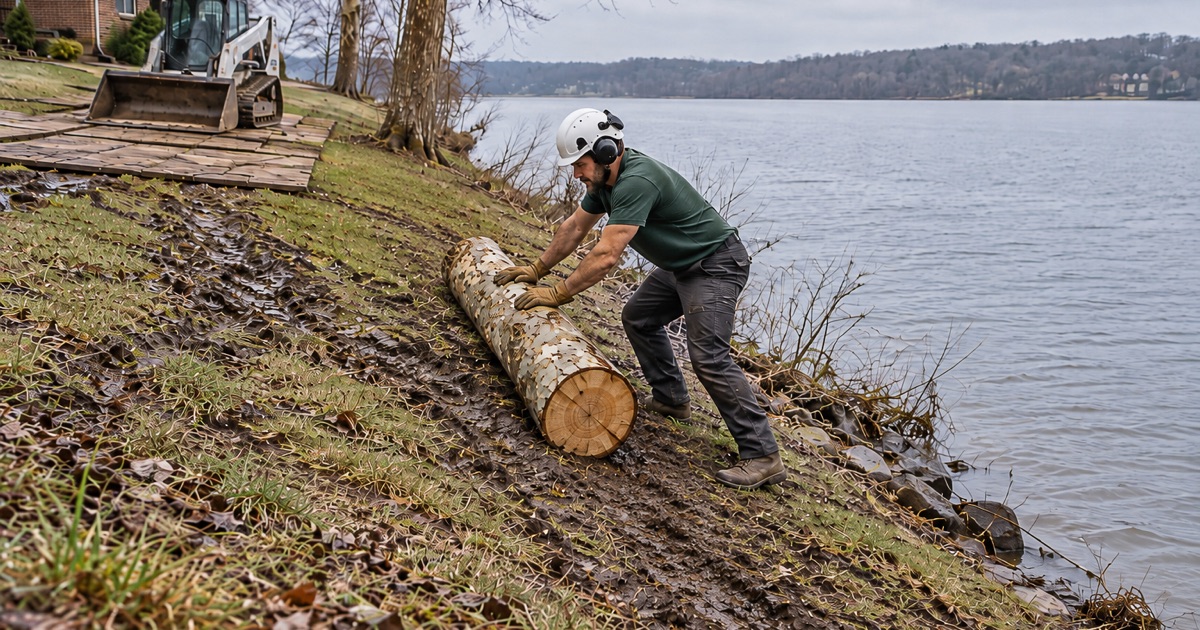
The corporate limits enclose 54.594 square miles of land and another 6.426 square miles of water at an elevation of about 594 feet. That is not a park boundary or a county figure; the Tennessee River and the Wheeler Lake shoreline sit inside the city, along with Flint Creek and Dry Branch. Waterfront and floodplain parcels are not an exotic assignment in this city; they are ordinary residential stock, and a crew that treats them as a special case prices them badly.
More than half of the housing units counted in the 2024 American Community Survey five-year estimates were built before 1980, which puts a lot of the city’s shade trees at fifty and sixty years of growth. On a bank lot that combination is specific: a mature crown, a soft toe of slope, and a drop zone that is partly water.
None of that makes a removal unusual, but it does make a sight-unseen phone quote worthless. The same species at the same diameter can be a straightforward morning on a level street and a full rigging job three blocks later, and the only thing that separates them is what the ground and the drop zone allow.
What the water changes about a quote
A tree that can be felled whole into an open yard is one price. The same tree with twenty feet of open water on one side, a dock beneath it, and saturated ground on the only approach a machine could use is a different job, and the difference is rigging time rather than sawing time.
We price that honestly by measuring it first. Where the wood can be dropped, whether the ground between the stump and the driveway will carry a machine or needs matting, and whether the brush has to be carried instead of dragged all move the number, and we would rather show you why on the estimate than discover it on the morning of the work.
Access is measured before the tree is priced
Gate width, drop zone, carry distance and the spot where a chipper is actually going to stand are written down before we quote. On a narrow lakeside lot the chipper often cannot come past the house at all, which means the brush comes forward to the street and the carry distance becomes a real line item rather than a surprise.
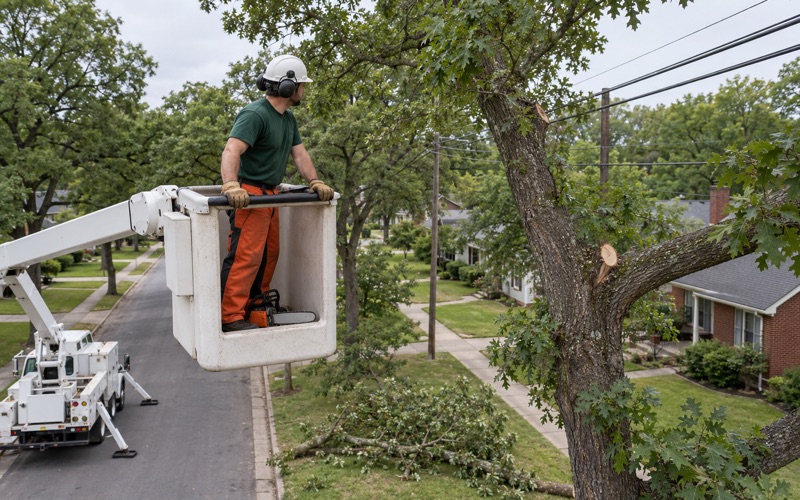
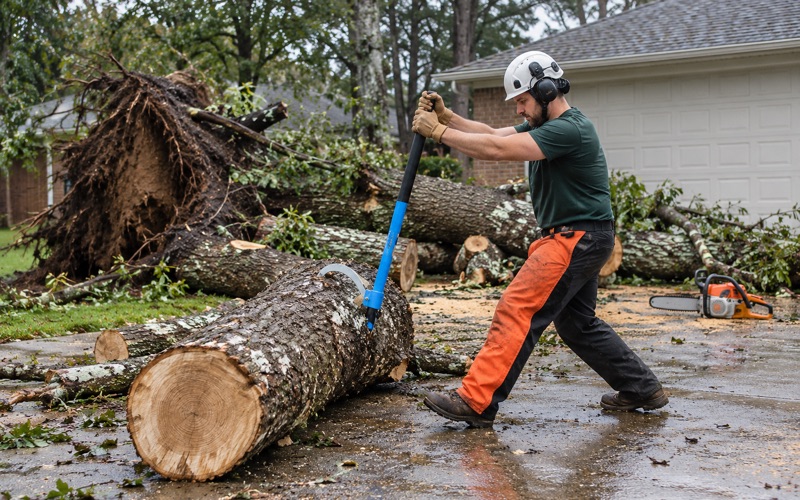
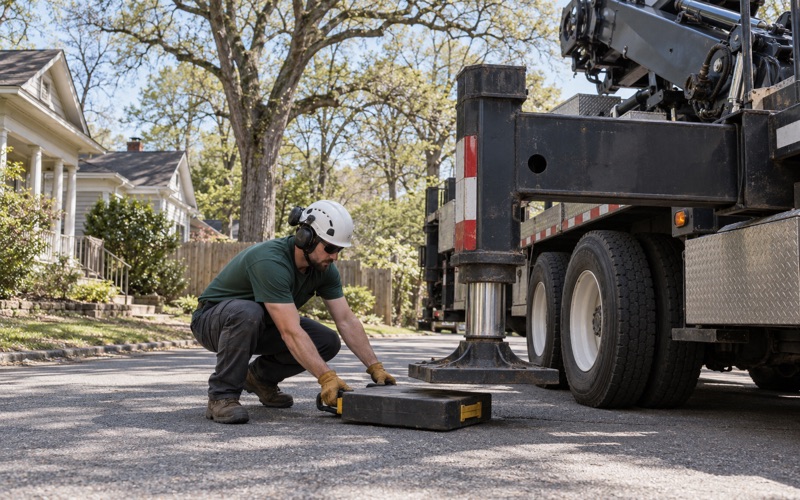
Where a bucket truck cannot reach, we use tracked lifts that fit through a back gate, and for trees standing over a roof we bring a crane rather than pick the roof apart in sections. On soft ground both decisions get made against what the soil will hold that week, not what it held in August.
Looking for tree service closer to Hartselle? See Tree Service Services in Hartselle.
Soft ground, saturated root plates and what a machine can stand on
Ground within reach of the water behaves differently in February than it does in August, and a crew that brings one plan for both leaves ruts across the yard as a souvenir. Before anything heavy comes down the side of a house on a low-lying lot, we decide what the soil will carry that week, where mats have to go, and whether the machine belongs on the property at all.
The strongest root system on the block is still only as good as the ground holding it. Saturated soil under a leaning stem is the condition that moves a tree from one we would watch to one we would take down, which is why an assessment on a bank lot is worth doing after a wet stretch rather than in the middle of a dry one.
Reading a lean on wet ground
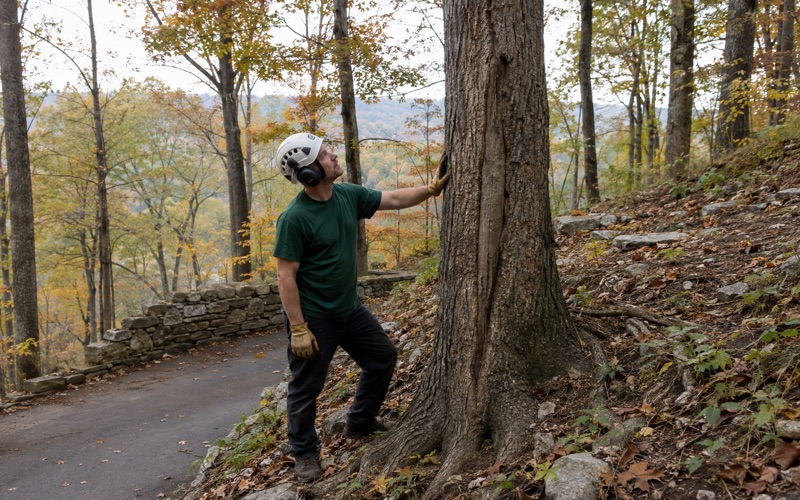
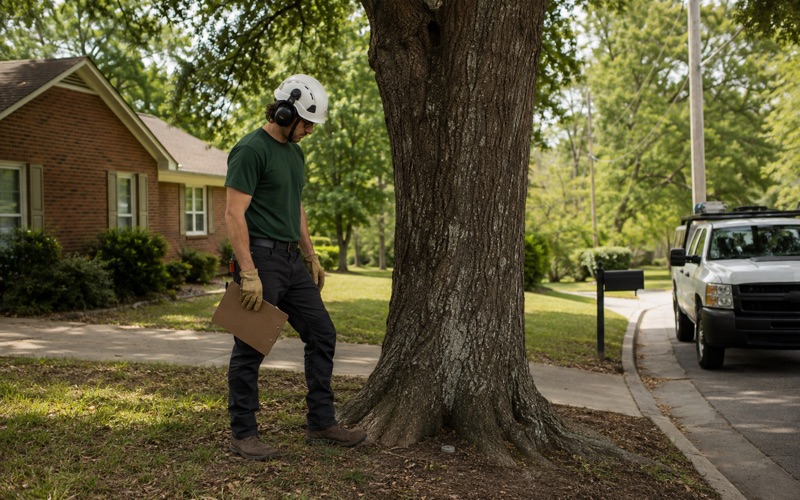
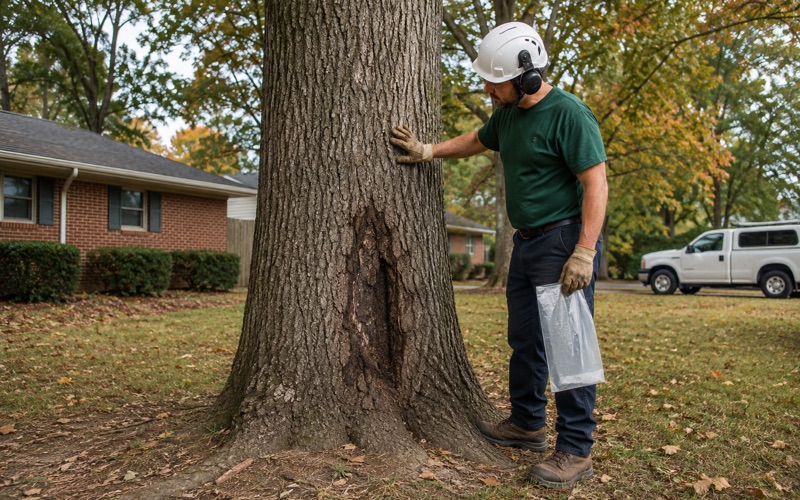
We check the root flare for bracket fungus and conks, sound the trunk with a mallet, and use resistance drilling where the sound is ambiguous. A decay column inside an otherwise healthy-looking stem, and a co-dominant union splitting at included bark, are the defects behind most of the removals we recommend, and neither is visible from a deck chair.
Storm and hazard calls get answered the same day. We will also say plainly when wind or ice has put a tree beyond safe reach for the moment, because the safety standard the trade works to sets real limits on aerial work near energized conductors in weather.
Stumps, and what goes in the ground before the wheel turns
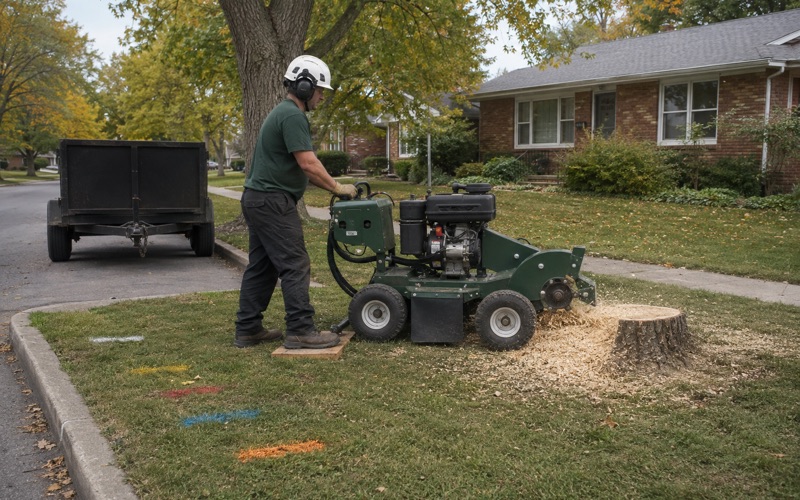
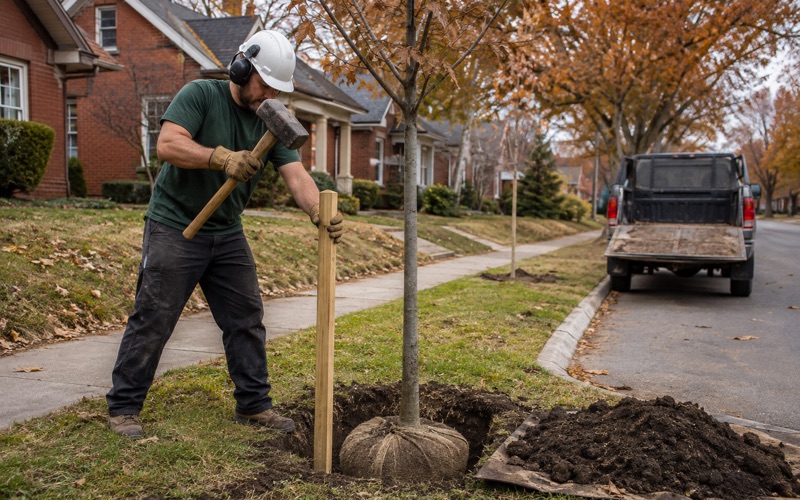
Grinding is excavation, so an Alabama 811 notice goes in before the cutting wheel turns, and the same holds for root collar excavation and any replanting hole. On a lot that runs down to water those marks matter twice over, because irrigation and low-voltage lighting tend to run the length of a bank rather than straight out from the house.
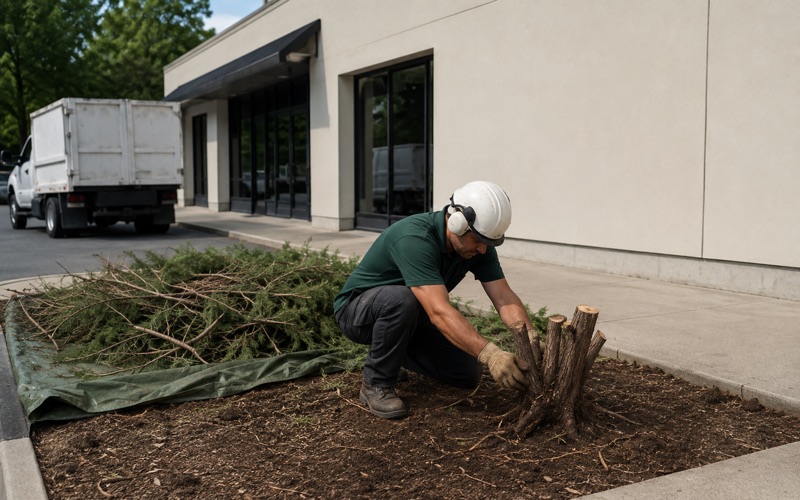
We quote a grind depth after looking at the stump, never before it. On soft ground we also say what happens to the grindings, spread, hauled or swapped for soil, because a mound of wet chips left sitting on a slope is a washout waiting for the next big rain.
Where the city stops and the federal refuge begins
Wheeler National Wildlife Refuge adjoins Decatur, and in places a residential property line is also the refuge line. Refuge ground is federally managed by the United States Fish and Wildlife Service, and that agency, not the homeowner and not us, is the authority behind any vegetation work on it.
We work the private side of that line. A tree that is rooted on refuge ground is not ours to cut, a limb is not ours to drop across the boundary, and brush does not get dragged over it to make a carry shorter. When the question is genuinely about refuge land, the answer is to take it to the refuge, and we will say so rather than guess.
Documentation for a boundary or an insurance question
Where a tree straddles a line, overhangs a neighbor, or has already come down on something insured, the useful product is a written record: species, diameter at breast height, defects observed, and what we would recommend and why. We price that as its own deliverable instead of folding it into a sales visit, so the report reads the same whether or not you hire us for the removal.
A shoreline lot generates more of those questions than an inland one, between shared banks, docks, easements and neighbors whose trees lean the wrong way. Getting the condition of a tree written down while it is still standing is cheaper than reconstructing it from photographs after it has fallen.
Wires are a third owner on the property
A tree on a primary conductor is a call to Decatur Utilities at 256-552-1400, option one, before any crew approaches it, and the utility’s own instruction on a downed line is to stay away from all of them. Gas is option two on the same number, with 911 first if there is fire.
The service drop between the pole and the house is the homeowner’s responsibility to clear, which surprises people every storm season. We say that up front, arrange the disconnect where one is needed, and explain which utility does what before the crew is standing in the yard.
Bank work, riverside species and where the wood goes
Both banks of the river here sit in the same Level Four ecoregion, 71g Eastern Highland Rim, inside the Interior Plateau. The water changes the ground conditions, not the species list: the upland community is oak and hickory, with cedar on the thin soils over limestone.
What the wet toe of a bank adds is the soft, fast-growing trees that tolerate saturated ground, and they behave differently on a rope. Brittle unions and included bark are ordinary in that group, which is why a bank tree that looks sound from the deck often comes apart in sections rather than as one stem.
Pines on a Decatur lot
The state authority for this part of Alabama names southern pine beetle as the number one killer of pines in the state, and unmanaged loblolly and shortleaf stands are the vulnerable ones. In drought the pitch tubes can be very small or missing entirely, leaving only reddish brown boring dust as a sign.
Under the bark, S-shaped galleries point to southern pine beetle, while Y-shaped or H-shaped galleries indicate Ips engravers. That distinction changes the urgency of a removal, so we look before recommending one.
Rigging a bank without putting debris in the water
Over water, nothing gets a free drop. Pieces come off on a bull rope through a rigging block, get lowered on a friction device at the base, or ride a speed line to a landing on firm ground away from the edge.
Sectional dismantling takes longer than felling, and the estimate says so. It is also the only way to take a lakeside tree apart without leaving brush and sawdust in the water, or a dock repair on the bill.
Debris is ours to haul, and the city says so
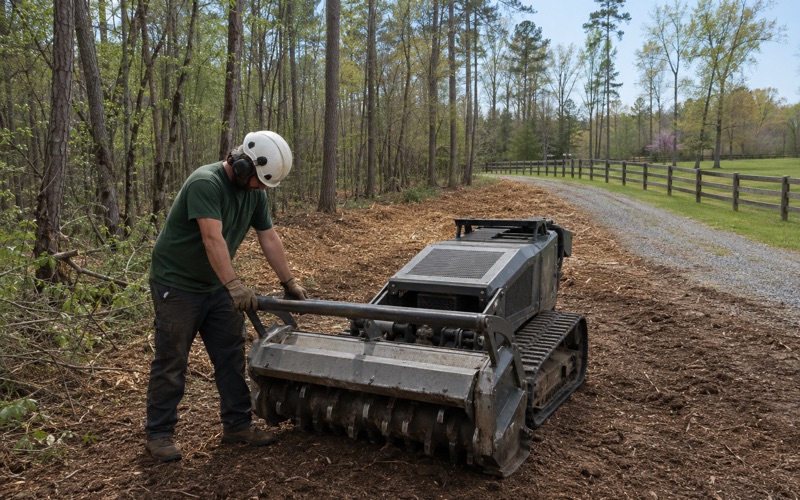
The City of Decatur requires contractors to haul their own debris away from work sites, the Solid Waste Department will not collect it, and homeowners are told not to negotiate with a contractor on the assumption that the city will. Our loads go to the Morgan County Regional Landfill in Trinity, which the city operates and which charges thirty dollars per ton with a sixteen dollar minimum, and that cost is on the estimate rather than in a dispute later.
What the city does collect from a homeowner is limbs cut to less than twelve feet in length and less than twelve inches in diameter, stacked neatly away from fences, mailboxes and utility poles, with bulk pickup unscheduled and running about two weeks. If you would rather keep the wood, rounds left cut and stacked earn a firewood credit on the same estimate, and when the carry is short enough to be worth it, our taking the wood away shows as a credit as well.
- 20+ Years in the Valley
- Free Written Estimates
- Same-Day Storm Calls