Huntsville Tree Removal Pros has been doing tree service in Hartselle for more than twenty years, and on a first visit here our crew looks at the ground before it looks at the trunk. Ridge ground in this part of Morgan County keeps rock close under the soil, and that single condition decides how a mature tree behaves when it finally lets go. It also decides what we can honestly promise before anyone has stood in the yard.
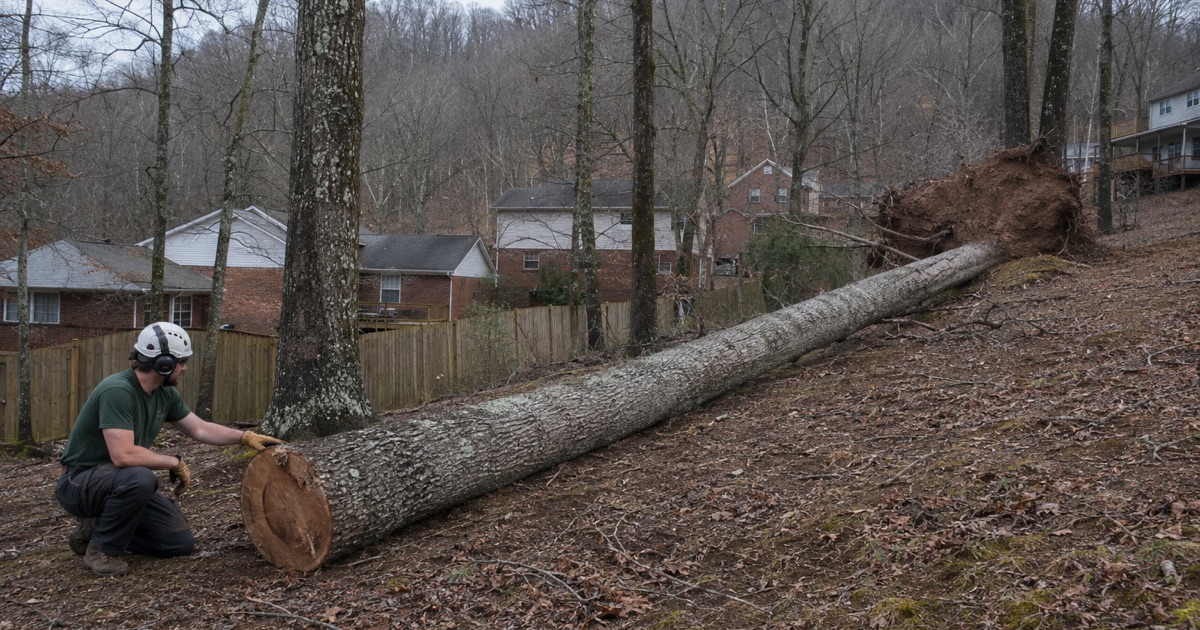
The removals we get called out for here are more often whole trees than broken ones. A tree comes over with its roots still attached, lifting a plate of turf and soil onto its edge and leaving a shallow crater where the flare used to stand. That failure tends to arrive in a wet winter rather than in a summer thunderstorm, which is not the season most homeowners are watching for.
So this page is about roots more than crowns. It covers how we read a root system nobody can see, when a lean is worth acting on, and how a takedown gets sequenced once saturated ground has already made the decision. Those are the questions a quote in this town actually turns on.
Ridge ground, sandstone, and a different kind of failure
Hartselle sits in EPA Level IV ecoregion 71j, Little Mountain, a narrow east-west ridge that parallels the Tennessee River inside the larger Interior Plateau. What separates 71j from the country around it is sandstone rather than limestone, and more forest cover than the surrounding rim carries. A point query on the valley floor immediately north of town returns 71g, the Eastern Highland Rim, so the boundary is close and it is real.
That distinction is not scenery, and it is the reason this page exists. On the limestone valley floor the residual soil is deep, and a mature root system can travel several feet down before it meets anything it cannot push through. On the ridge it cannot, and everything below follows from that one limit.
The soil that forms over the sandstone
The soils mapped over this sandstone in Morgan County are the Hartsells series: moderately deep, well drained, moderately permeable soils formed in loamy residuum weathered from acid sandstone containing thin strata of shale or siltstone, on nearly level to moderately steep ridges and upper slopes. Depth to bedrock and solum thickness range from 20 to 40 inches. On more level ground the Nauvoo and Wynnville series occur alongside it, formed in residuum from the same rock.
Twenty to forty inches is not a topsoil measurement, it is the entire rooting profile on the shallower end of that range. The forest vegetation named for these soils is oak species, tulip poplar, blackgum, hickory and pines, and not one of them gets a vote about how deep it is allowed to go.
A wide plate instead of a deep anchor
A tree denied depth compensates with width. Rather than a deep anchoring system, a mature oak or hickory on ridge ground here builds a broad, shallow root plate that can reach well past the drip line while staying inside the top two or three feet of soil. Structurally that behaves like a dinner plate balanced on a post, not like a stake driven into the ground.
In ordinary weather the plate holds perfectly well. What it cannot tolerate is the soil around its rim losing strength, because a wide plate resists overturning through weight and friction rather than through depth. When that goes, the trunk does not snap; the whole tree rotates out of the ground in one piece, and there is no partial version of that failure to catch halfway.
This is why we do not price a Hartselle removal from the street or over the phone. The evidence that matters is at the ground line, under mulch, turf and whatever the last landscaper added, and none of it is visible from a driveway.
Looking for tree-removal closer to Arab? See Arab Tree-Removal.
Reading a lean on ridge ground
Not every leaning tree here is a hazard, and treating them all alike is how a homeowner pays to take down the wrong one. A stem that grew toward light over decades has laid down wood to hold that posture, and the soil around its base is settled and undisturbed. That tree has been leaning since well before the current roof went on.
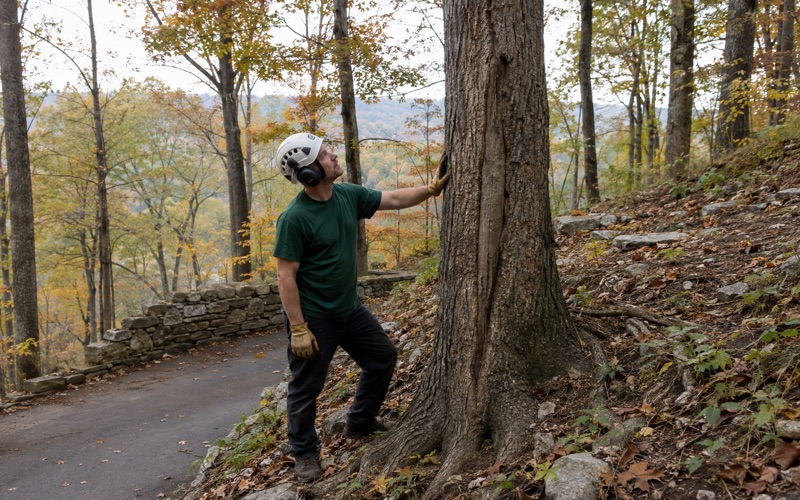
A lean that is actually moving looks different at the ground rather than in the crown. Soil cracks open in an arc on the side away from the lean, turf lifts along that arc, and the root flare rides slightly proud of grade where the plate is beginning to tip. Those signs show up at the base first, which is exactly where nobody is looking.
Where the tree would land changes the urgency but not the reading. A wide-plate tree tipping over open pasture is a scheduling question; the same tree tipping toward a bedroom wall, a shop roof or a service drop is a same-week question, and we will say which one we think it is.
Saturated ground is the trigger
The reason a wet winter matters more than a windy afternoon is that a shallow plate is held by the soil it happens to be buried in. Weeks of rain with no leaves on the canopy and very little evaporation leave that soil heavy and weak at precisely the depth the plate occupies. A gust the tree shrugged off in August can push the same tree over in February.
Hartselle lies in National Weather Service public forecast zone ALZ007, which covers Morgan County, doubles as its fire weather zone, and is served by the Huntsville forecast office. The county immediately to the north sits in a different forecast zone, so a wind headline issued for that zone does not cover this ground. We read the zone that actually applies before telling anybody their tree can wait another month.
Inspecting a root plate you cannot see
Everything decisive about a tree here is buried, which makes an inspection a matter of excavation and inference rather than a long look upward. We start at the root flare, because on a shallow-plate tree the flare is where the structure tells the truth. A flare buried by grading, piled mulch or a raised bed hides the exact wood we need to look at.
What the base tells us
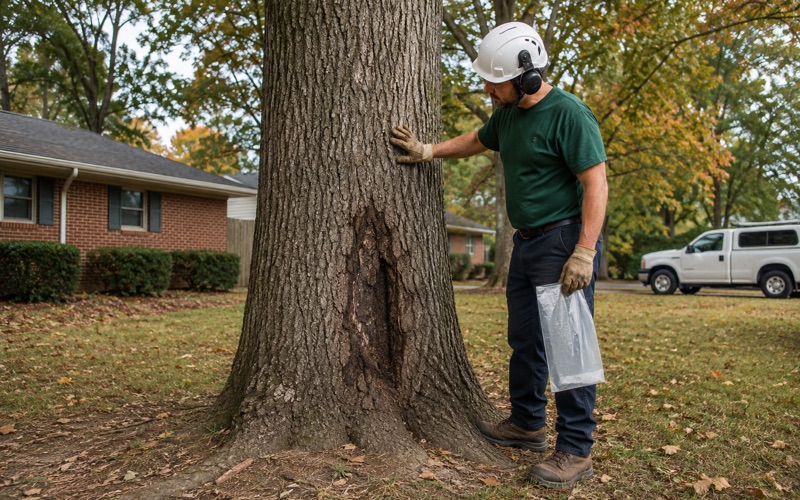
Girdling roots crossing the flare, a bracket fungus or a conk sitting at the root collar, bark that sounds hollow under a mallet, and soil separated from the trunk on one side all point at one question: how much sound wood remains where the plate meets the stem. A decay column rising out of the root collar counts for more on a wide plate than on a deep root system, because there is less anchorage underneath it to spare. Where the collar is buried, an air-excavation device strips soil off it without severing roots, and resistance drilling measures sound wood in places a sounding mallet leaves ambiguous.
We also map what has happened inside the critical root zone. A driveway poured over roots, a trench cut for a line, fill added during an addition, or heavy equipment parked on wet ground during a remodel each removes anchorage a shallow plate cannot afford, and one of them is very often the reason a tree that stood for decades started moving this year.
The honest limit of mitigation
A tree with a co-dominant union and included bark is a different problem with a different answer, and static or dynamic cabling can carry a union that is worth keeping. Nothing cables a root plate. Once anchorage is gone the tree is a removal, and we would rather say that than sell a mitigation that does not address the part of the tree that is failing.
Documentation, boundaries and digging
Written condition and risk documentation is its own deliverable here, priced on its own line rather than folded into a sales visit. It is what an insurance claim and a boundary letter actually need. Alabama’s rule for a tree on a property line was settled by the Alabama Court of Civil Appeals in Young v. Ledford in 2009, and a written record of the tree’s condition before anything is cut is worth considerably more than a recollection afterward.
Any root excavation or digging starts with an Alabama 811 notice, with locates marked within 48 hours. On a lot where the plate runs out under a yard full of buried services, that notice is what keeps a root collar inspection from turning into a repair.
Getting it down before the weather does
Access decides the method
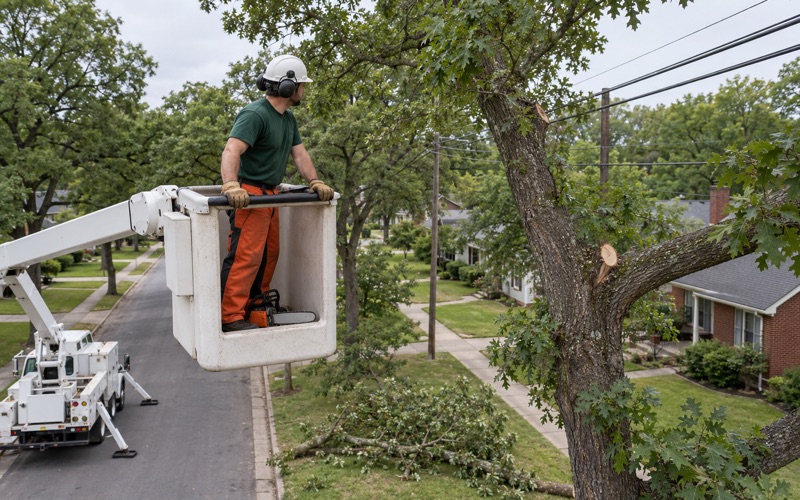
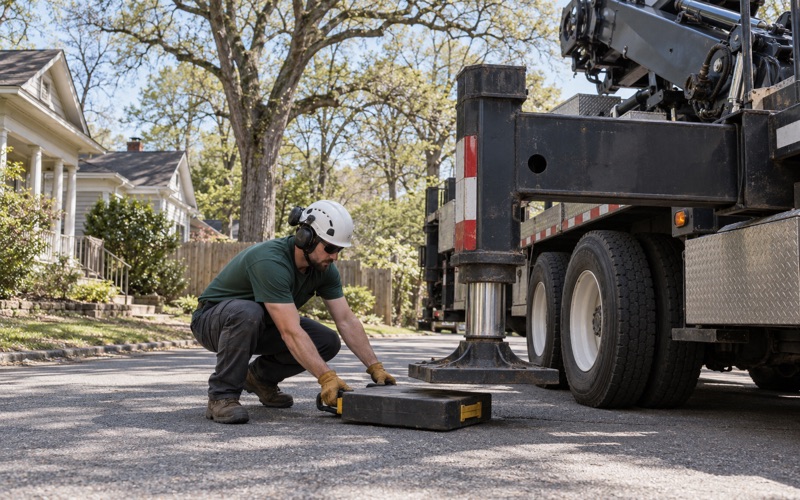
A tree whose anchorage is already suspect is not a tree to climb. The load a climber and a rigging system put into a stem is transferred straight down into the plate that is in question, so on those trees a crane or a tracked spider lift stops being an upgrade and becomes the only responsible way to take the top out. For sound trees in tight yards we still work aloft, dismantling in sections with a rigging block and a Port-a-Wrap, and a knuckleboom grapple truck clears wood from the drop zone as it comes down.
Access gets measured before the tree gets priced, and the measurements are specific: gate width, drop zone, carry distance back to the truck, and where a chipper that will never fit through a back gate is actually going to sit. Getting that wrong is what turns a firm quote into a change order on the day.
Lines, and the call that has to go to the right place
Inside the Hartselle city limits, electric service comes from Hartselle Utilities, which is a legally separate entity from the City of Hartselle. Outside the city limits, rural Morgan County is served by Joe Wheeler Electric Membership Corporation instead, and the two have their own procedures that do not transfer between them. A downed or arcing conductor inside the city goes to Hartselle Utilities at 256-773-3340, life safety and fire go to 911, and dialing the wrong one during a storm costs response time nobody has.
The service drop between the pole and the house is the homeowner’s to clear, and we say so before the work is booked, arrange the disconnect, and explain plainly which body does what. The industry’s ANSI Z133 safety requirements put firm limits on working near energized conductors in high wind and ice, and there are storm mornings when the correct answer is that a tree waits for daylight or for the utility.
How the estimate reads
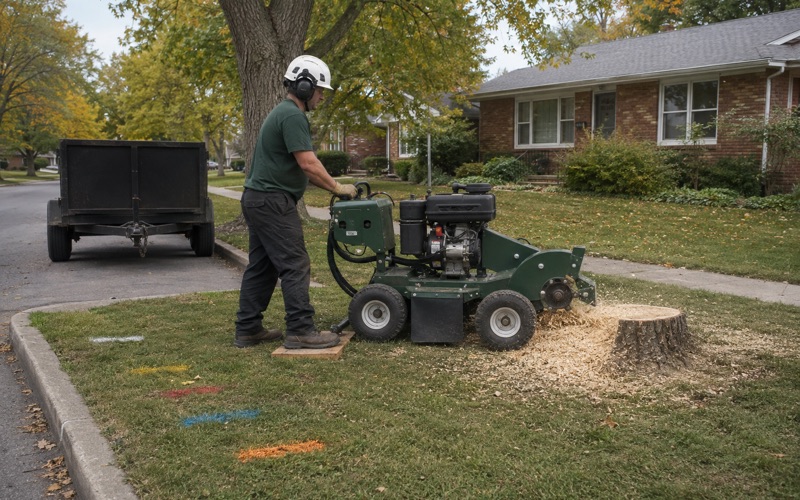
Our estimate separates the takedown, the stump and the debris into three priced lines, because those are the three numbers competing quotes disagree about and a single total hides which one is different. Haul-away is written on the quote in words, included or not included, so a cheap number and an expensive number can be compared honestly. Rounds left cut and stacked earn a firewood credit that appears on the same estimate, and where the carry is short enough to be worth it, taking the wood shows as a credit too. On ground where the anchorage is the variable, knowing which of those three numbers you are actually comparing is what keeps a decision from turning on the wrong one.
- 20+ Years in the Valley
- Free Written Estimates
- Same-Day Storm Calls