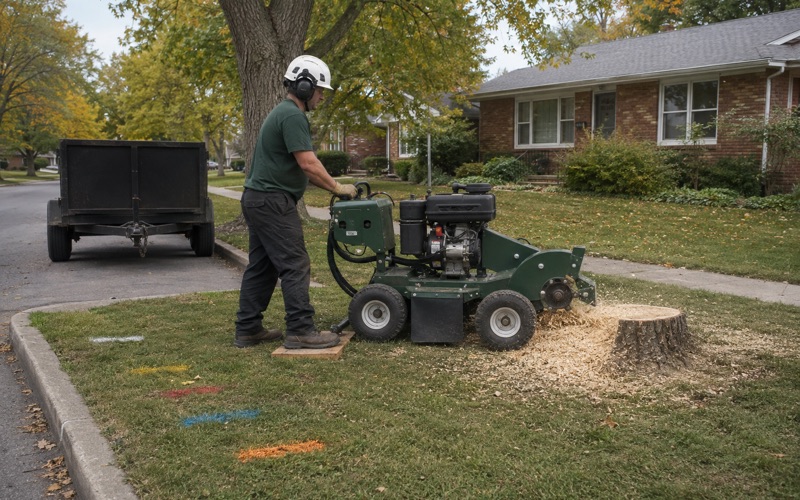
Huntsville Tree Removal Pros has handled tree removal in Harvest for more than twenty years, and the first thing we want to know about a tree on a lot here is what it has already been through. Our written estimate separates three numbers, the takedown, the stump and the debris, because those are the three lines competing quotes disagree about. Haul-away is stated on the same page in words, included or not included, so a cheap bid and an expensive one can be compared honestly.
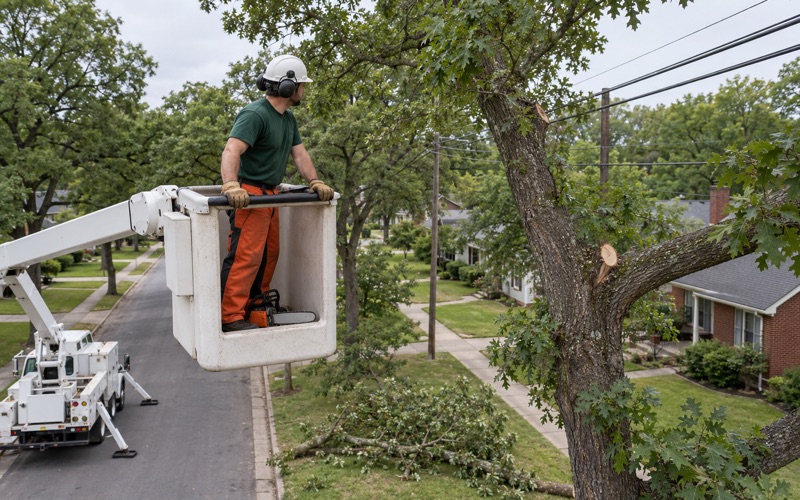
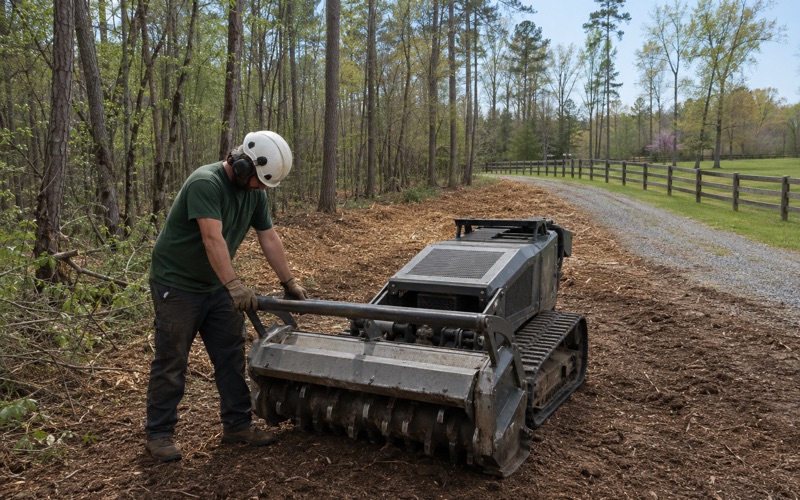
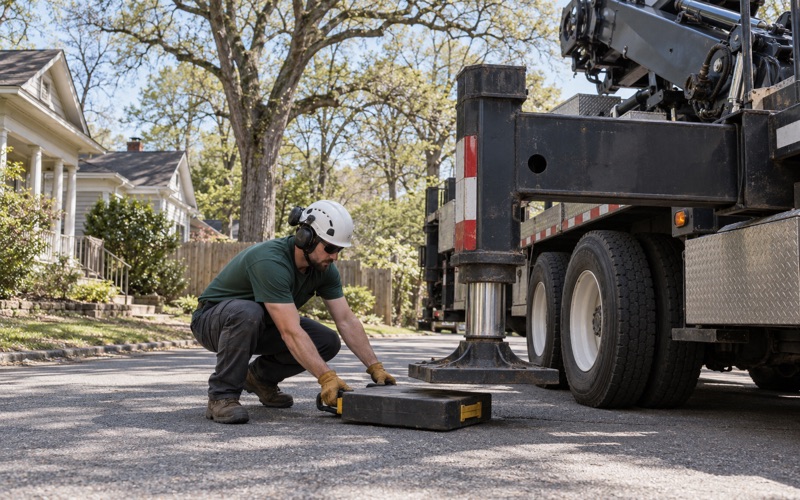
Access gets measured before the tree gets priced. Gate width, drop zone, carry distance back to the truck and where a chipper that will never fit through a side gate is actually going to sit all move the number, and we would rather settle that standing in the yard than on the morning of the job. For a stem hanging over a roof we bring a crane or a tracked spider lift, and for a fenced back yard no bucket truck can reach, a narrow-access machine goes in instead.
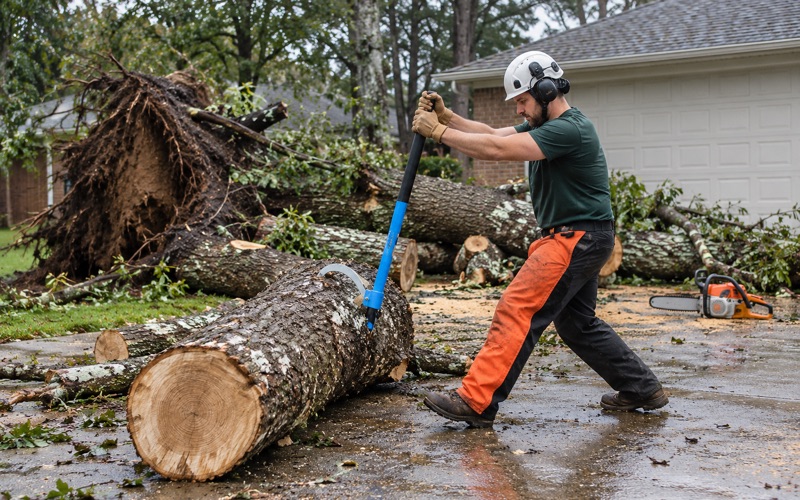
That matters more here than it does on most streets we work, because a federal damage survey names roads in this community outright. Storm and hazard calls get answered the same day, with the plain limits an industry safety standard puts on working near energized conductors in high wind and ice.
What the damage survey actually recorded on these roads
The National Weather Service office in Huntsville surveyed the tornado that crossed this community on April 27, 2011 and rated it EF-5, with a peak wind of 210 mph, a path length of 106.9 miles and a maximum width of 1.25 miles. It was on the ground from 3:28 p.m. to 5:20 p.m., crossing Franklin, Lawrence and Limestone counties in Alabama, then Madison County, then Franklin County, Tennessee. Those figures describe the whole track. What the survey records about this ground in particular is narrower, and far more useful to anyone standing in a yard here.
The tornado entered Madison County from Limestone County near the county prison at roughly a half-mile width and held EF-3 strength across several roads. Near Anderson Hills it narrowed to about 300 yards, and inside that width winds of 140 to 160 mph destroyed dozens of well-constructed homes, in some cases collapsing every exterior wall of single-story and two-story houses alike. The survey has it lifting south of Patterson Lane after damaging irrigation equipment and trees.
Three hundred yards is a property-line number
A path a mile and a quarter wide is a regional figure. A path three hundred yards wide is a street-by-street one: a row of houses took wind that took the walls down, and the row behind it took a fraction of that. Where a lot sat relative to that narrowing is the first thing we are working out on a walk-through, because it sets how hard to look at everything still standing on it.
The last line of the survey is about trees
The detail we keep returning to is the one at the end, irrigation equipment and trees damaged as the tornado lifted. Tree damage was recorded that day as damage, not as debris, and the trees carrying it were not all taken down afterward. Some of them are still in yards that have been mowed around them every summer since.
Looking for tree-removal closer to Meridianville? See Tree-Removal Services in Meridianville.
Why surviving that track did not make a tree sound
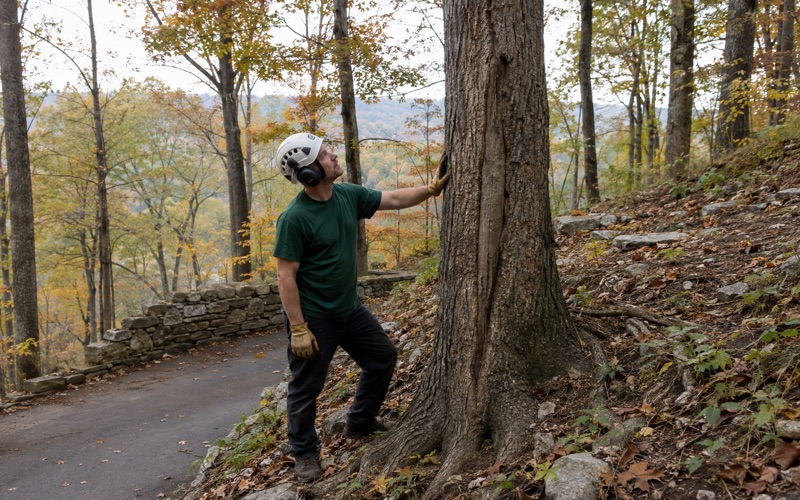
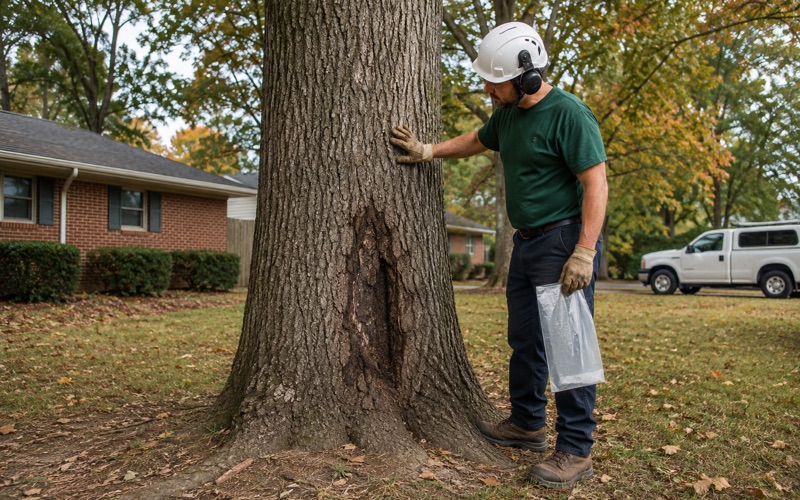
An owner usually reads a tree that stayed upright through 140 to 160 mph wind as proof of strength, and sometimes that is exactly what it is. Just as often it is a tree that was loaded well past what its wood could carry and simply did not fail on the day. That kind of loading opens cracks at the union of co-dominant stems, tears roots on the tension side of the root plate, and shifts a root flare an inch or two without ever laying the trunk over.
What fifteen years does to a wind crack
None of that closes back into sound wood. Water and fungi reach the opened crack, and a decay column widens through it season after season while the crown overhead still looks ordinary from the driveway. A bracket fungus on the trunk or a conk at the root flare is the late and visible stage of something that began on an April afternoon.
Reading an old injury in a crown today
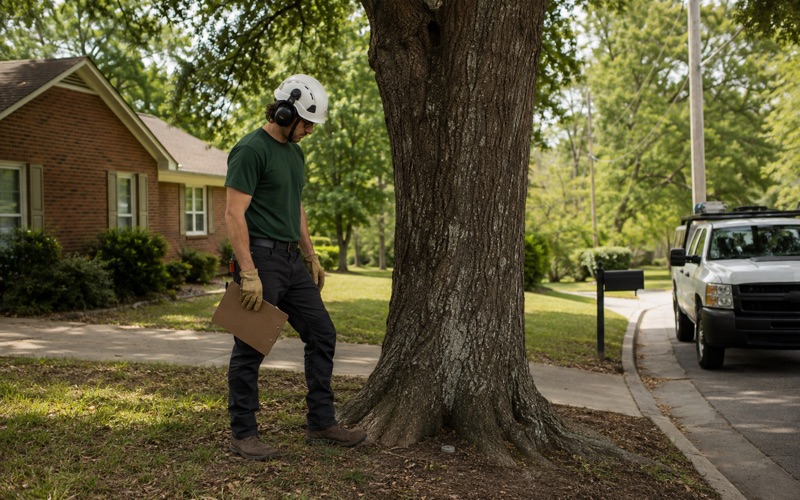
An inspection on this ground is mostly a hunt for mismatches. A crown thinner on one side than the other, dieback confined to the upper third, epicormic sprouts breaking out along a limb that quietly lost its own foliage years ago. We sound the trunk with a mallet and follow the places where the note changes with resistance drilling, because a hollow that shows on a drill trace is a measurement to decide from rather than an impression to argue about.
Included bark is the failure that waits
Co-dominant stems with included bark are the union high wind finds first and leaves worse than it found it. Sometimes the honest answer is removal. Sometimes it is a static or dynamic cabling system, or crown reduction to take sail area off the weaker leader, and when keeping the tree is defensible we would rather price that option too.
Standing hazards in the yards along the track
A great deal of what borders lots here is edge timber, trees that spent decades inside a closed woodlot and now stand at an open margin. Loblolly and shortleaf pine along that edge sit in exactly the unmanaged stand condition the Alabama Forestry Commission describes when it names southern pine beetle the number one killer of pines in the state.
Pitch tubes are the familiar sign, though the agency notes that in drought they may be very small or absent, leaving only reddish-brown boring dust on the bark. Gallery shape settles the question: S-shaped galleries under the bark are southern pine beetle, while Y- or H-shaped galleries are Ips engraver beetles. Which one it turns out to be changes how quickly the tree needs to come out and whether the pines beside it are next.
Ash on these lots picked up a new problem in 2025
The Alabama Forestry Commission confirmed emerald ash borer in Madison and Jackson counties on June 6, 2025, the first confirmed observation in either. Its guidance is that infested ash trees which are cut down should preferably be burned or destroyed on site to slow the insect’s dispersal. That collides directly with the disposal question, which is a reason to settle disposal on the estimate rather than in the driveway on the day.
Cut wood does not go to the curb
Madison County Waste Control and Recycling collects household garbage and large items, and it does not pick up debris generated by contractors; a resident who hires someone for yard work is told the contractor is responsible for removing what the work produces. Tree stumps are named outright among the things the county will not take. Our haul-away line is written with that already accounted for, and rounds you want kept get left cut and stacked for a firewood credit that shows on the same estimate.
The span between the pole and the house
Huntsville Utilities holds the distribution right of way across this part of Madison County and runs a line clearance program, but its published position is that clearing trees off the service wire running from the pole to the house rests entirely with the customer. We say so up front, arrange the disconnect, and explain which part of the job the utility will handle before anyone leaves the ground. That is a different answer from the one a rural cooperative gives, and assuming the wrong one costs a working day.
What we do before the next warning rather than during it
Harvest sits in National Weather Service public forecast zone ALZ006, served by the Huntsville forecast office and radar station KHTX, which means a warning here arrives with very little of the afternoon left in it. Nothing worth knowing about a hazard tree can be worked out inside that window. The useful version of this work is a walk-through on an ordinary Tuesday, when a crown can be looked at properly and a removal can be scheduled instead of triaged.
Documentation priced as its own deliverable
We write condition and risk documentation as a separate line rather than folding it into a sales visit, for boundary letters to a neighbor, for insurance claims, and for the height questions that come up near the airfields. Where a limb crossing a property line is the subject, the Alabama authority is Young v. Ledford, decided by the Court of Civil Appeals in 2009, and a dated written record of a tree’s condition carries further than anybody’s recollection of how it looked before the storm.
Who actually signs off on a tree here
There is no city here to issue a permit. Harvest is an unincorporated census-designated place, so no municipal tree ordinance, landscape requirement or removal threshold applies to a lot in it. What usually applies instead is the recorded declaration of covenants for the subdivision, filed with the Office of the Judge of Probate of Madison County, and that is the document to read before anyone quotes a diameter limit for a particular street; anything standing in the county road right of way is Madison County Public Works’ call.
Storm work, with the limits said out loud
We take storm and hazard calls the same day, and we also say plainly what the ANSI Z133 safety requirements for arboricultural operations rule out near energized conductors while wind and ice are still on them. A crew that promises to work straight through that is promising something no one should. The tree that came down in this community has an obvious cost; the one still standing with a fifteen-year-old crack in it is the one worth a look before the next warning goes out.
- 20+ Years in the Valley
- Free Written Estimates
- Same-Day Storm Calls