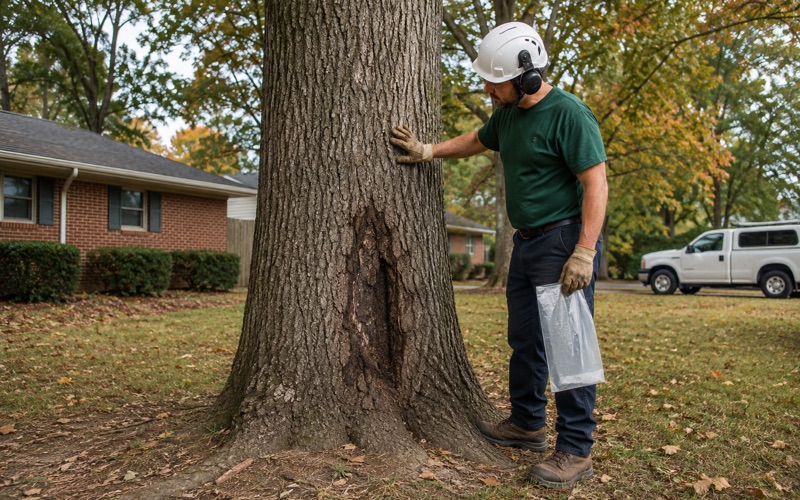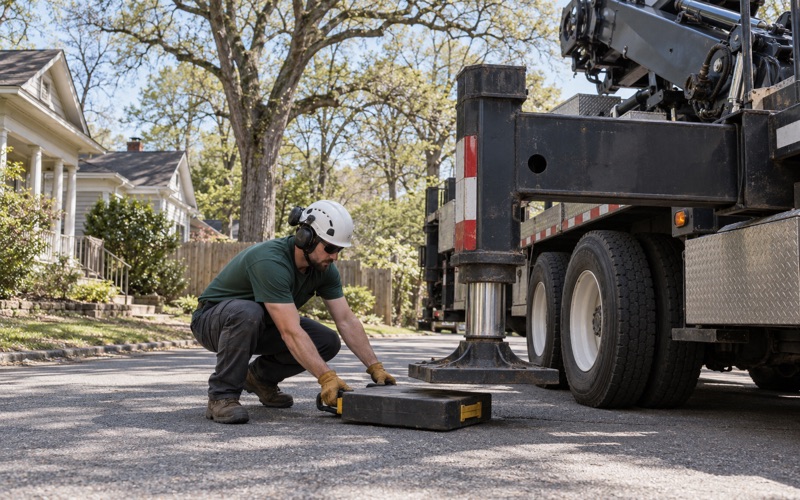
Huntsville Tree Removal Pros has been doing tree removal in Hazel Green for more than twenty years, and the trees we are called out to here are rarely forest trees. They are yard trees, fence-row trees and road-frontage trees: wide, low-forked specimens that grew up with nothing crowding them. They fail in ways a tall, stand-grown trunk does not, and they get priced differently for the same reason.
Our estimate splits into three lines with a number on each one, the takedown, the stump and the debris. Those are the three figures competing quotes disagree about, and separating them is the only way to tell whether a cheap bid and an expensive bid are describing the same job. Haul-away is written on the quote in words, included or not included, instead of being left to assumption.
Access gets measured before the tree gets priced. Gate width, the drop zone, the carry distance back to the truck, and where a chipper that will never fit through a gate is actually going to sit move the number more than trunk diameter does. On a long rural frontage, that walk is a real part of the job.
Why the biggest trees here stand alone
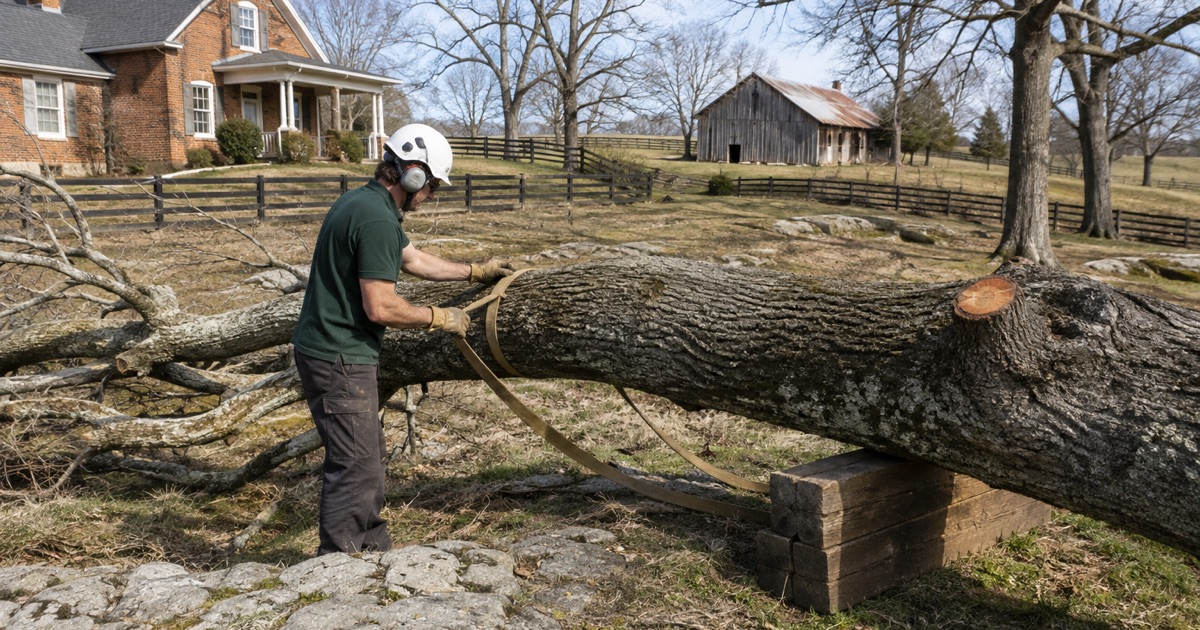
Farmers from Georgia, Tennessee and the Carolinas began moving into this area by around 1810, after word spread that the soil was among the richest in the Southeast. They came for ground to farm, and they cleared it to farm it. That decision, made more than two centuries ago, is still the best single explanation for what the canopy looks like today.
What surrounds a house here is not woodland with homes cut into it. It is farmland with a scatter of open-grown specimens standing over homesteads, in fence rows and along road frontage, with cleared ground in between. A tree in that position never competed for light with anything, and it grew accordingly.
The housing stock follows the same pattern. ACS 2024 five-year estimates count 1,540 housing units in the community, 88.8 percent of them one-unit detached, and 32.0 percent built before 1980. The oaks shading those older houses are often as old as the house or older, which means decades of lateral limb weight has accumulated over a roof that was built underneath them.
The species vocabulary is the Eastern Highland Rim’s: oak and hickory on the deeper ground, eastern redcedar where soil runs thin over limestone. That is a different assemblage from the cove hardwoods of the escarpment slopes, and assuming the wrong one leads to wrong expectations about wood strength and how decay travels.
What that history changes about a quote
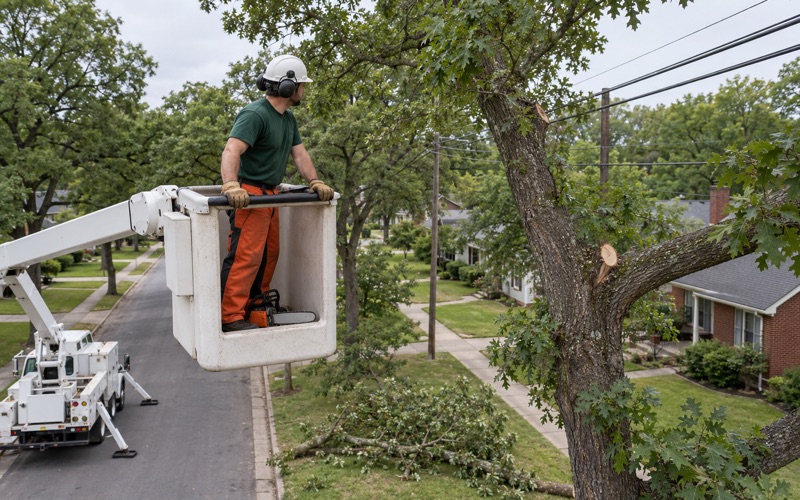
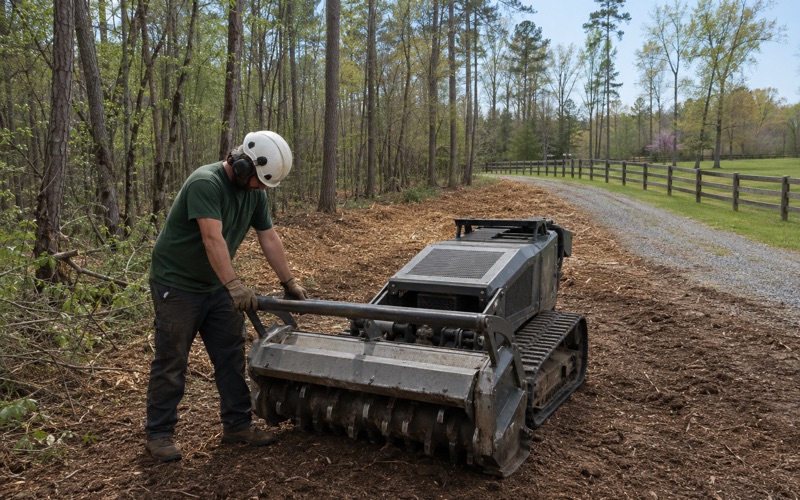
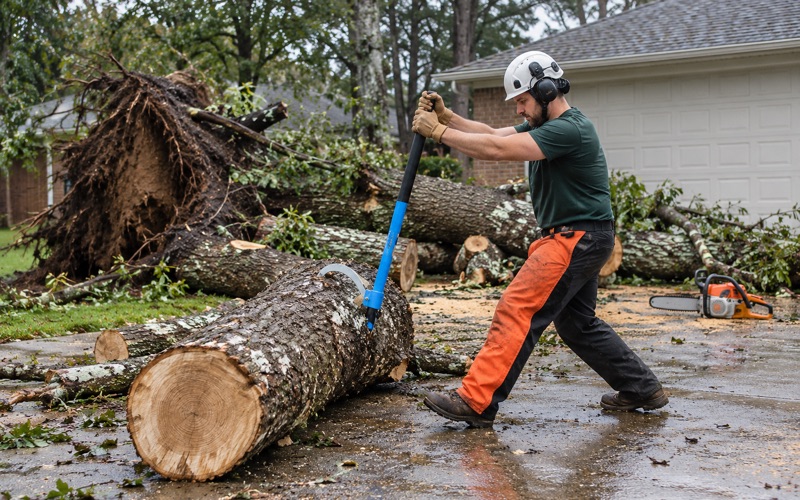
Most of what we take down here is a single large tree standing in the open rather than a crowded stem in a stand. The practical question stops being how to fell it into a gap and becomes what can reach it. We run crane and tracked spider lift work for trees standing over a roof, and narrow-access machines for fenced back yards no bucket truck is getting into.
Looking for tree-removal closer to New Market? See New Market Tree-Removal.
An open-grown crown, and where it breaks
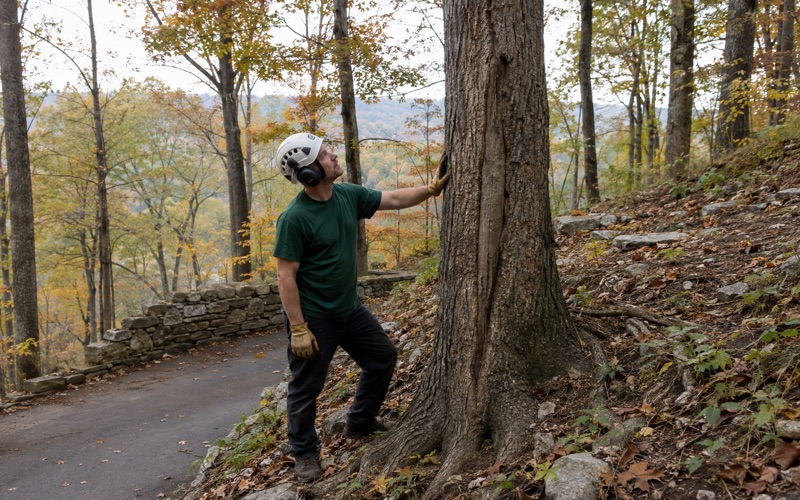
A stand-grown tree spends its growth on height, holding a straight stem with a small crown at the top because the trees beside it allow nothing else. An open-grown tree spends the same growth on width. The result is a short trunk, heavy laterals reaching far out from the stem, and forks low enough to put a hand on.
Those long laterals are levers. Weight at the end of a thirty-foot horizontal limb loads the union at its base every time the wind moves it, and the union is usually where the tree gives out first. Where two stems of similar size rose together, the fork is frequently a co-dominant union with included bark rolled into the seam instead of wood grown across it, and that connection has far less strength than its size suggests.
Why the soil pushes the risk up into the crown
The upland soils through these valleys are the red clayey Decatur and Dewey series. Decatur carries a solum more than 72 inches thick with limestone bedrock deeper than six feet; Dewey runs more than 60 inches to rock. A tree with that much rooting depth available can hold a deep root plate, so it is less automatically a windthrow candidate, and trunk and union defects therefore carry proportionally more of the total risk.
What we look at before we recommend taking it down
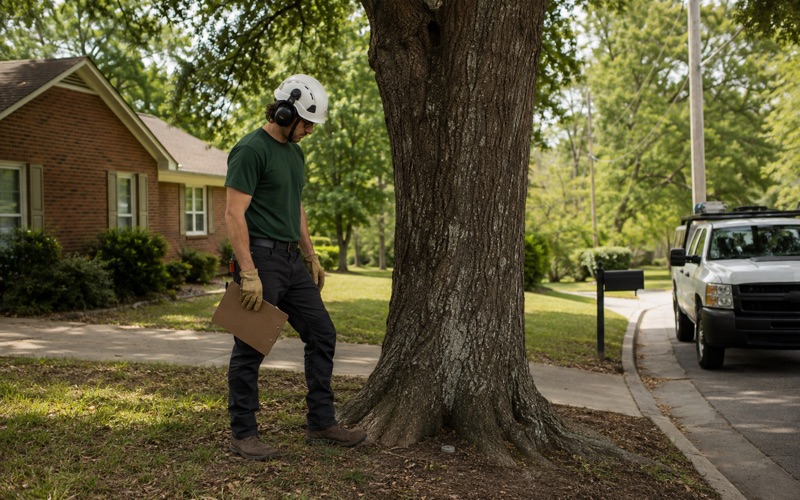
We start at the root flare, looking for girdling roots, a bracket fungus or a conk at the base, and any sign the flare has been buried. A sounding mallet finds hollows a photograph will not, resistance drilling sizes a decay column when the sounding is ambiguous, and diameter at breast height sets the load the defect is being asked to carry.
A tree that has never had competition also declines in a readable way. Dieback shows at the outer ends of those long laterals rather than at a suppressed crown top, and a flush of epicormic sprouts along a bare limb is the tree answering a loss of leaf area somewhere below. On a specimen with nothing beside it to blame, that response points back at the roots, the flare or a decay column in the stem.
Not every bad union ends in a removal. Crown cleaning and reduction shorten the lever the limb is swinging, and static or dynamic cabling systems and threaded steel bracing rods can hold a fork that is otherwise sound wood. When you need the finding on paper for a boundary letter or an insurance claim, written condition and risk documentation is priced as its own deliverable rather than bundled into a sales visit.
Road frontage, the right of way and the wires
Frontage trees raise the question of whose tree it is before anything else. The county road right of way in unincorporated Madison County is held and managed by Madison County Public Works, at 266-C Shields Road in Huntsville, 256-746-2900, open Monday through Friday from 7:00 a.m. to 3:30 p.m. That is the department to reach about a county road, a blocked roadway, or work inside the road right of way.
Overhead, the distribution utility is Huntsville Utilities. It performs line clearance on its own lines at no cost to the customer, using natural trimming to laterals as an ISA recommended practice, with a Line Clearance Planner leaving a door hanger that explains the planned work. Where it removes a street-side tree it grinds all stumps resulting from that removal and offers a one-for-one replacement voucher for up to three trees at participating nurseries.
The service drop is the exception, and it decides who pays for the most common wire job on a rural frontage. The utility’s own published answer is that “the responsibility of clearing trees from customer service wires (pole-to-house) rests entirely with the customer.” We say that at the estimate rather than at the truck, arrange the disconnect, and spell out which part of the wire run belongs to whom.
Storm work, and the limits on it
Storm and hazard calls get answered the same day. They also come with plain limits: the ANSI Z133 safety requirements for arboricultural operations govern how close a crew may work to energized conductors, and high wind and ice narrow what can be done safely rather than widening it. For any life-safety emergency, a tree on a structure, or a tree on an energized line, call 911 first, and report an outage or a downed conductor to Huntsville Utilities at 256-53-LIGHT (256-535-4448).
Before the grinder goes in
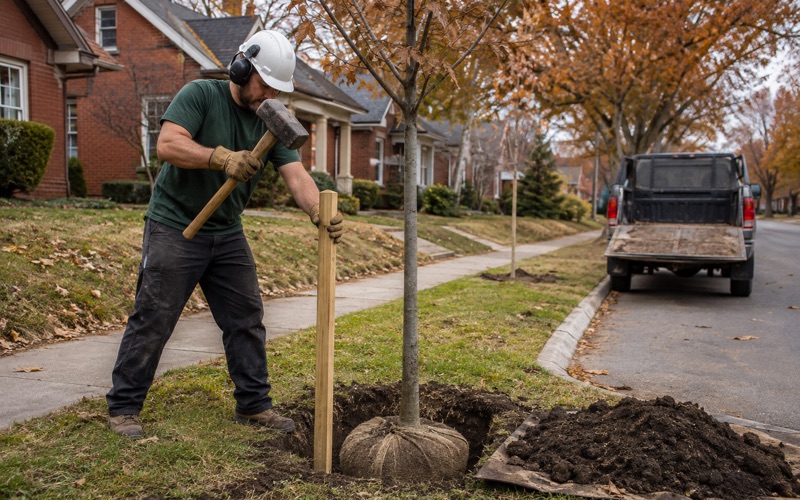
Alabama requires notice of intent to excavate at least two but not more than 10 working days before the work starts, and the notice stays valid for 20 working days from the proposed start date. Stump grinding is not named in the statute’s inclusions or its exemptions either way, so we take the conservative reading and call it in before grinding near a service lateral.
Homestead trees, the property line, and the wood left over
Hazel Green is an unincorporated census-designated place, which settles a question people expect to be complicated. No municipal tree ordinance, landscape regulation, brush rule or removal permit reaches a parcel here, and the governing body is the Madison County Commission. The county enforces building code instead, the 2018 International Residential Code with local amendments since January 2021, and no county tree permit or diameter threshold applies to taking a tree off a finished residential lot.
Old homesteads and old fence rows put trees directly on lines, and that is a legal question rather than a climbing one. Under Alabama law a tree whose trunk stands on the boundary is treated as the common property of both owners, settled by the Alabama Court of Civil Appeals in Young v. Ledford in 2009, so we ask for the neighbor’s agreement in writing before the saw comes out. Where the trunk sits wholly on one side, the tree belongs to that owner no matter where the crown reaches.
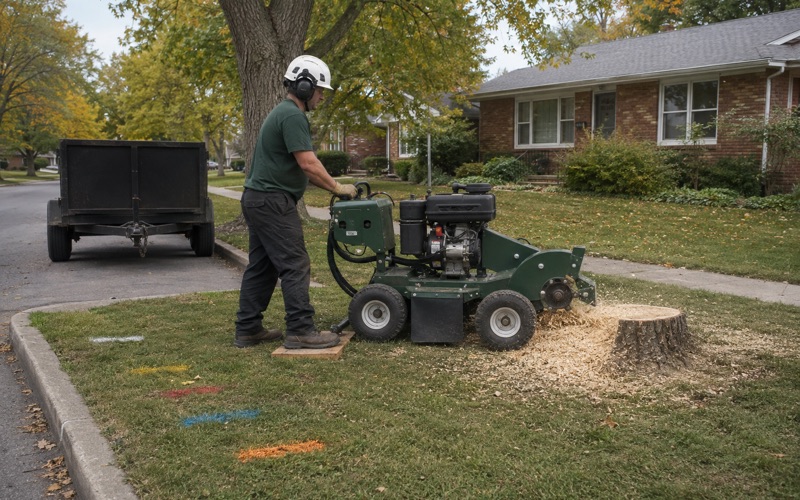
Deep residual soil means bedrock is not what stops a stump grinder in this community. A machine rated to cut 12 to 25 inches below grade reaches the bottom of its own cut, so grinding depth is a machine-class and pricing decision here rather than a geological one, which is why the stump carries its own line on the estimate.
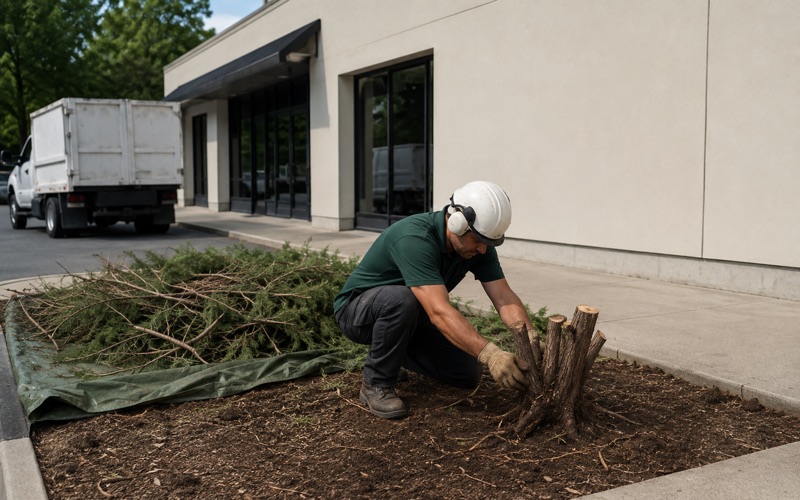
The debris line matters more here than it does in town. Madison County Commission District 1 administers large debris collection for this community, states that “We do not pick-up debris generated by contractors,” and names tree stumps among the items it does not collect. Wood left at the curb after a contracted job is wood that stays at the curb, so we put the hauling arrangement in words. Rounds left cut and stacked earn a firewood credit on that same estimate, and taking the wood away shows as a credit too when the carry is short enough to be worth it.
Ash is its own decision right now. The Alabama Forestry Commission identified the emerald ash borer in Madison and Jackson counties on June 6, 2025, and its guidance is that infested ash trees cut down should preferably be burned or destroyed on-site to slow the insect’s dispersal. The state quarantine covers ash logs, stumps, roots, branches and chips not ground small enough to destroy the insect, with no restrictions on moving regulated articles solely within regulated areas, so where the wood is going is settled before the tree comes down rather than after.
- 20+ Years in the Valley
- Free Written Estimates
- Same-Day Storm Calls