Huntsville Tree Removal Pros has handled tree removal in Madison for more than twenty years, and on a job inside this city the first thing we establish is not the species or the lean. It is which county the property sits in. Madison’s corporate limits cross the Madison and Limestone county line, and that line decides more about the work than anything visible from the driveway.
It sets which electric utility holds the distribution right of way over your street, which National Weather Service forecast zone your wind warning is issued in, and which assessor’s office values the house a tree would land on. Two homes carrying the same mailing city can answer all three of those questions differently.
What follows the county question is priced the way we price every removal in the Tennessee Valley. The takedown, the stump and the debris go on three separate lines, haul-away is stated on the quote in words rather than left to be assumed, and access is measured before the tree is priced: gate width, the drop zone, the carry back to the truck, and where a chipper too wide for a side gate is actually going to sit.
Which county your Madison address is in, and how to tell
Madison lies primarily in Madison County and extends west into Limestone County. It is an enclave of Huntsville, which surrounds it on all sides, with small unincorporated pockets inside the limits in both counties and along the Huntsville border. The city covers 30.563 square miles of land at an elevation of 686 feet, under one municipal government and two county governments.
The split is written into the city’s own code
This is not a map curiosity that only surveyors care about. Sections 3-3-3, 3-4-8 and 3-4-9 of the Official Zoning Ordinance, effective July 1, 2026, measure the damage threshold for a nonconforming structure against a tax appraisal value determined by “either the Madison County or Limestone County tax assessors’ offices.” A code that has to name two assessors was drafted for a city that sits in two of them.
Three documents that answer it
Your electric bill is the fastest check, because the provider named on it is county-specific inside Madison. Your property tax notice names the assessing county outright. A point forecast pulled for your own coordinates returns a zone named either Madison or Limestone. We ask for the first of those before quoting anything that stands near a wire.
Why we ask before the estimate, not after
A removal that ends in an insurance file or a letter to a neighbor about a boundary tree has to name the right county in it. We write condition and risk documentation as its own priced deliverable rather than folding it into a sales visit, and a wrong jurisdiction at the top of that document is the first thing the reader on the other end catches.
Looking for tree-removal closer to Triana? See Triana Tree-Removal.
The utility on your line is set by that boundary, not by your mailing address
The City of Madison’s public works utility directory divides electric service by county in plain words: Madison City within Madison County is served by Huntsville Utilities at 256-535-1200, and Madison City within Limestone County by Athens Utilities at 256-232-1440. Same city, same postal format, two different companies holding the right of way over the street.
Which number goes first when a tree is on a conductor
If a limb or a trunk is lying on a primary line, the call goes to the provider for your county before it comes to us. On the Madison County side, Huntsville Utilities operates a Line Clearance department for vegetation inside its own distribution right of way, reachable at 256-535-1224 or trees@hsvutil.org. We will make that call alongside you rather than leave it to be sorted out at two in the morning, and nothing gets cut until the status of the line is settled.
The pole-to-house wire is the homeowner’s
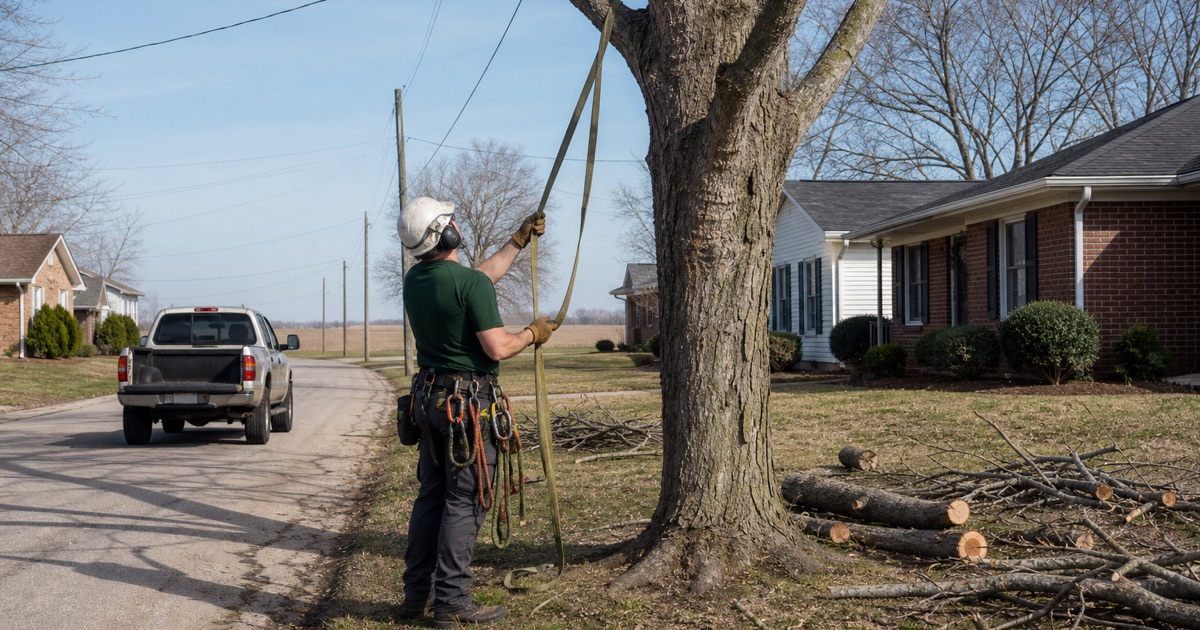
Huntsville Utilities states that the responsibility of clearing trees from customer service wires, pole to house, rests entirely with the customer. The service drop is the wire running from the pole at the street to the attachment point on the wall of your house, and it is not the heavier primary line strung pole to pole above it. That single sentence is the most misread rule in this trade, and it is why a homeowner can spend a week waiting on a crew that was never coming for that wire. We say it at the estimate, arrange the disconnect for the service drop before we work above it, and explain which utility in this ring does what.
What a utility’s own removal covers
On street-side trees that it removes itself, Huntsville Utilities grinds the resulting stumps and offers a one-for-one replacement voucher for up to three trees at participating local nurseries. Both are limited to street-side trees it removed. A back yard tree, or a tree taken down because a customer asked for it, falls outside that program, and planting and the disposal of grinding debris stay with the customer either way.
Two forecast zones inside one city, and what a warning really covers
Madison is divided for weather the same way it is divided for power. A National Weather Service point query at 34.6993, -86.7483 returns public forecast zone ALZ006, named Madison, with county zone ALC089. A query at 34.7150, -86.8000 returns ALZ005, named Limestone, with county zone ALC083. Both points report their relative location as Madison, AL.
Same office, same radar, a different warning box
Both halves are served by the Huntsville forecast office and the KHTX radar, and in each case the public zone doubles as the fire weather zone. What changes is the shape the warning is drawn on. A wind advisory or a high wind warning can be issued for one half of Madison and not the other, so a household a few miles west can sit under an alert its neighbors never receive.
Reading it before the storm rather than during it
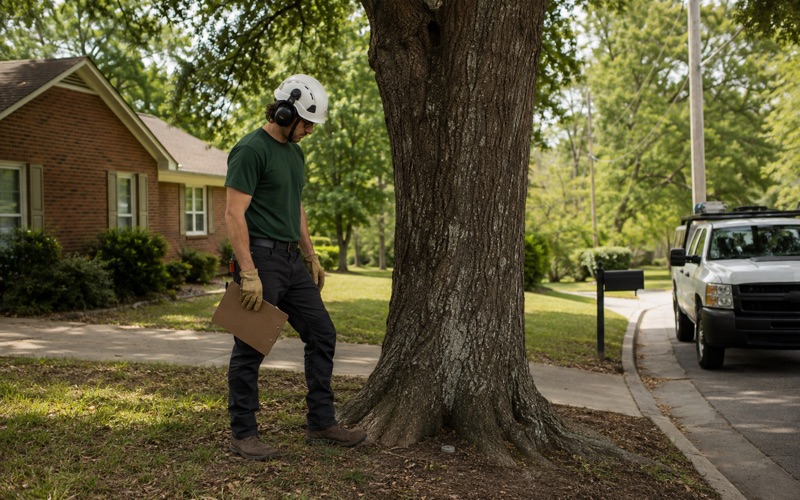
Note both zone names once and keep them somewhere. If the alert reaching your phone is keyed to the county you are not in, you are reading a forecast written for someone else. A heavy one-sided crown, standing dead wood in the scaffolds, or a co-dominant union with included bark is worth booking on a clear week rather than on the night the wind arrives.
What high wind stops us doing
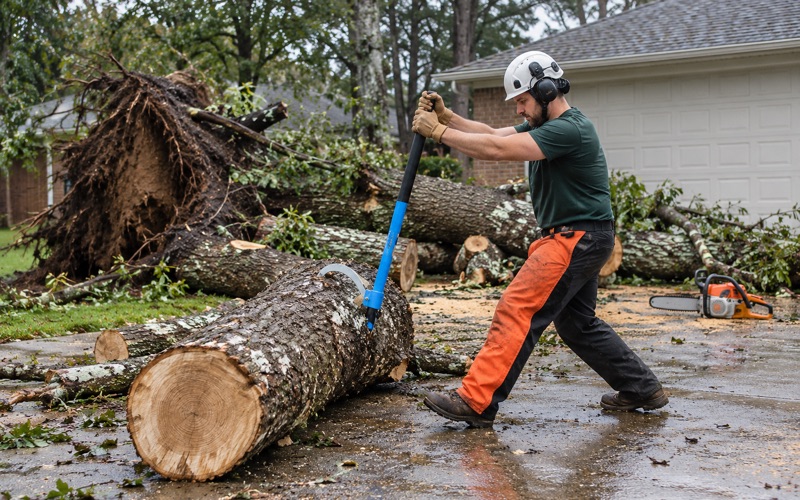
Storm and hazard calls are answered the same day. They are not answered by climbing a moving crown beside an energized conductor: the ANSI Z133 safety requirements for arboricultural operations set plain limits on work near energized conductors in high wind and ice, and those limits are why a careful crew sometimes secures a roof at midnight and cuts at first light. The storm record here is a record of dated events rather than an average. Thirty-nine tornadoes occurred in the Huntsville forecast area on April 27, 2011, including an EF4 in Madison County with a 27.2-mile path 880 yards wide, and no yearly frequency figure is published for this area, so we do not quote one.
What the county line does not change
The ground under both halves is the same. Madison sits on the Eastern Highland Rim, on deep soils formed in limestone residuum. The Decatur series, whose type location is in Limestone County, carries a solum more than 72 inches thick with limestone bedrock deeper than six feet, and the Dewey series on these same uplands runs more than 60 inches to rock. Both are well drained.
What deep soil means for a stump
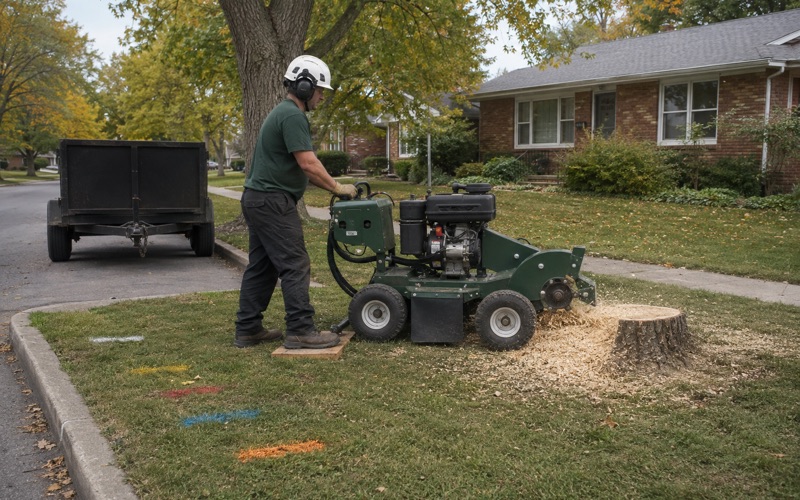
Depth to rock well past six feet changes what can be promised on a grind. The constraint here is the machine’s own rated cut, commonly 12 to 25 inches below grade depending on machine class, rather than a cutting wheel finding stone at eight. On these soils a below-grade depth can be committed to in writing, and it goes on the estimate as its own line rather than as an assumption. What comes back out of the hole is the other half of that line, because grindings bulk up well past the volume of the stump, and whether they are raked back in, spread, or carried off is priced rather than left to be settled in the driveway.
And what it means for the way trees fail here
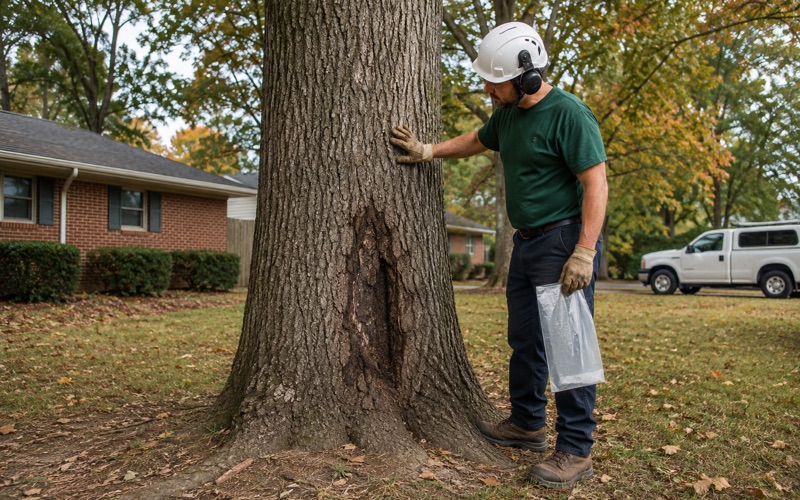
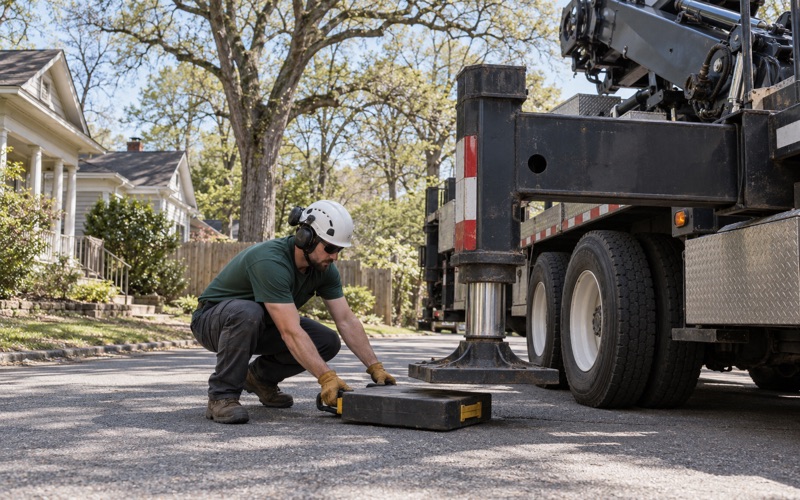
Deep, well drained residual soil lets a mature tree build a genuine root plate, so the failure we are called to on a settled Madison lot is more often a limb or a union letting go than the whole tree tipping out of the ground. That points the inspection at unions, included bark and decay in the scaffolds. It also decides the iron: crane and tracked lift work for trees standing over a roof, and narrow-access machines for fenced back yards no bucket truck was ever going to reach.
The debris rule is citywide, and it excludes contractors
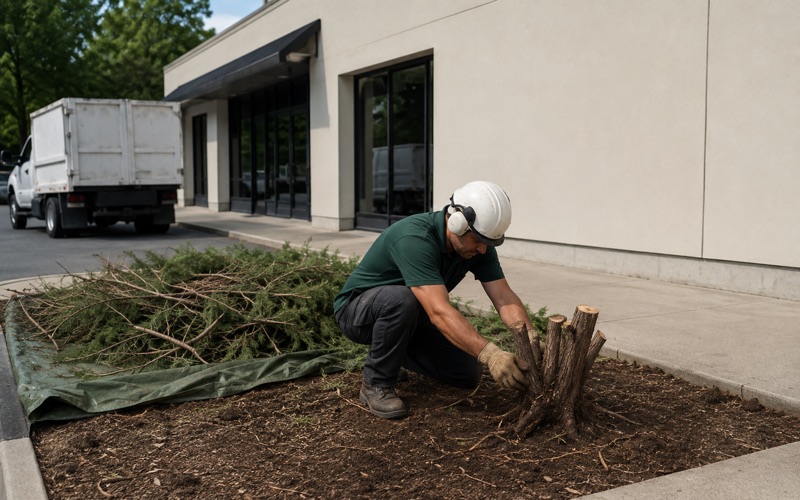
Yard debris collection is contracted by the city to Republic Services on both sides of the county line: five cubic yards per household per week, with tree limbs cut to lengths not exceeding eight feet, protruding branches trimmed, stacked in a neat pile. The same brochure states that waste generated by commercial workers or professional lawn services cannot be put out for collection. A removal’s brush pile is ours to haul rather than the city’s to take, which is why haul-away is written into the quote instead of discovered on collection day. Rounds left cut and stacked earn a firewood credit on that same estimate, and taking the wood away shows as a credit too when the carry is short enough to be worth it.
The same brochure carries a staging rule worth following even when the pile itself is within the limit: nothing goes out beneath or next to power and cable lines, low hanging branches, mailboxes, traffic signs, or on top of a sewer drain. We stage to that rule on the day, because a pile a truck cannot reach safely is a pile that stays on your curb.
One zoning ordinance over two counties
The zoning ordinance applies to the whole city whichever county an address falls in, and it does regulate trees. Natural vegetation must be preserved along property lines and drainage ways under Section 4-13-1, an existing tree of at least four inches caliper can earn a preservation credit under Section 7-5-1.G, and street trees run at a maximum spacing of 40 feet on center. Those are development-side rules, and Section 7-5-3 applies its landscaping standards in all zoning districts and to all uses other than single family detached dwellings. For a homeowner clearing a tree out of a finished yard, the county answer is still the one that changes the phone call.
- 20+ Years in the Valley
- Free Written Estimates
- Same-Day Storm Calls