Huntsville Tree Removal Pros has spent more than twenty years on tree removal in New Market, and the crews who work this community treat cold injury as a standing part of the inspection rather than a rare finding. A removal here is often the last step in a sequence that started with one hard freeze several winters back. Reading that sequence backward is what tells us whether a tree wants a cable, a reduction, or a takedown.
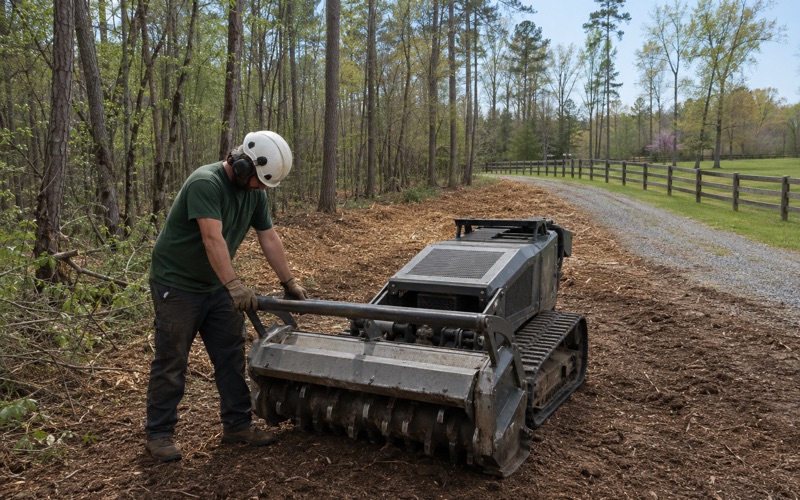
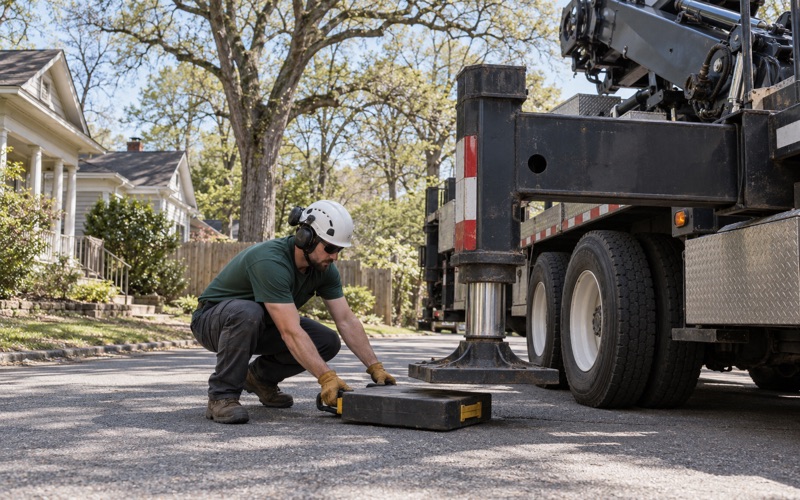
We price the takedown, the stump and the debris as three separate lines, because those are the three numbers competing quotes disagree about, and haul-away is stated on the page in words — included, or not included. Access gets measured before the tree gets a price: gate width, drop zone, carry distance to the truck, and where a chipper that will never fit through a gate is actually going to sit. On a rural parcel with a long drive and a fenced back yard, that measurement is most of the estimate.
New Market is an unincorporated community in northeast Madison County, which matters far less for the tree than for the paperwork around it. No municipal ordinance reaches a parcel out here, and none of that status changes how a trunk comes apart. What it does decide is who signs off on the work, and who will not be collecting the wood afterward.
The coldest morning Alabama ever recorded happened here
The lowest temperature ever recorded in the state of Alabama, minus 27 degrees Fahrenheit, was recorded at New Market on January 30, 1966. That is a single station observation and a state record, not a description of an ordinary winter here, and we hold that line carefully. The reading was extraordinary; the reason behind it is permanent, and it is still sitting under the community.
New Market lies in a valley at roughly 791 feet, at the toe of the plateau front. On a clear, calm night, air chilled against the higher ground upslope grows denser than the air around it, drains downhill, and collects in the low ground the way water would. The valley floor therefore ends the night colder than the slope above it, and that gap belongs to the terrain rather than to the season.
A zone forecast and a station reading are different numbers
This community sits in National Weather Service public forecast zone ALZ006, which covers Madison County as a whole. A low temperature issued for that zone is a county-wide value, not a measurement of what happened in this valley overnight. When a customer tells us the forecast read well above freezing and we are standing in front of split bark, those two facts are not in conflict — the forecast was for the zone and the tree was in the pool.
So we ask what a particular tree came through rather than what the season averaged. One night of deep cold does more structural damage than a whole winter of ordinary frosts, and the damage usually does not announce itself until the tree tries to push growth in spring. We date the freeze events we work around, because a defect is easier to read when its age is known. Bark that separated three winters ago behaves differently under a rigging load than bark that opened last month, and that difference decides where a climber ties in.
Looking for tree service closer to Decatur? See Tree Service in Decatur.
Frost cracks and radial shakes, and what spring shows
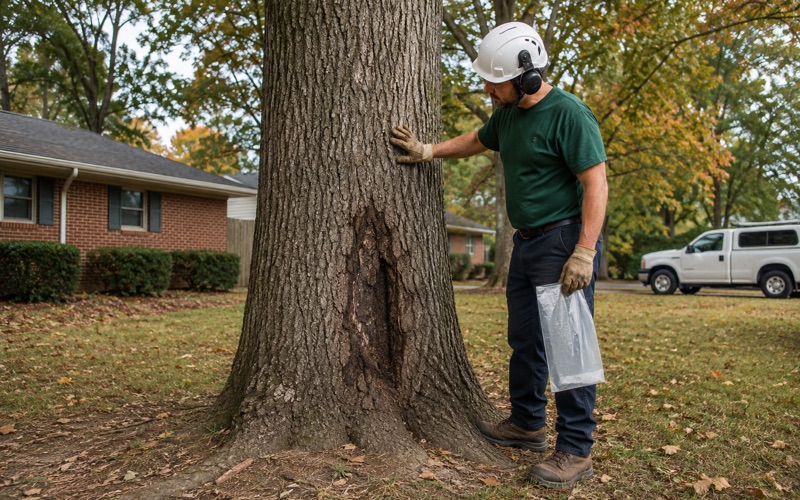
Deep cold splits wood because the outer shell of a trunk cools and contracts faster than the wood at its center. When the two layers move against each other far enough, the trunk fails in tension along a radius: a vertical frost crack on the surface, with a radial shake running inward from it. Thin-barked trees take this worst, and younger maples, beech, yellow poplar, cherry and fruit trees carry too little insulation on their south and southwest faces to buffer the swing.
What we actually look at
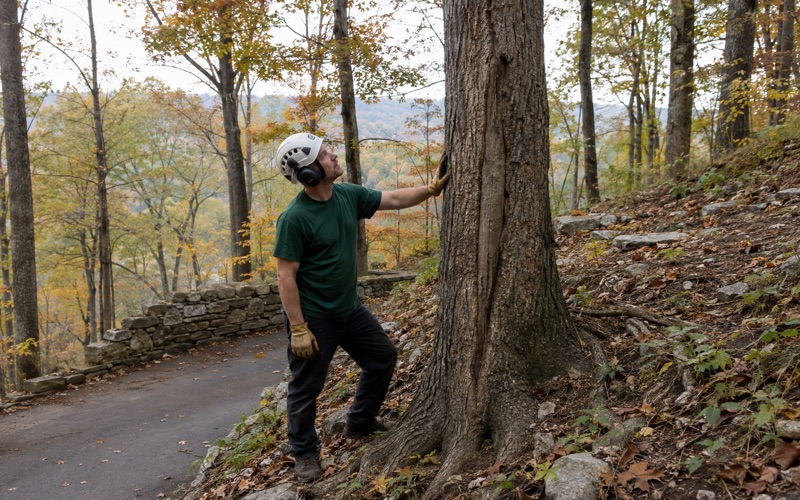
A fresh crack is easy to see; an old one is the thing worth finding. Cracks reopen in the same place winter after winter, and the callus ridge built along each edge is a record of how many times it has happened. We sound the trunk with a mallet along and beside the seam, because a hollow note beside a healed crack often means a decay column has gotten into the split. Where the sounding is ambiguous, resistance drilling gives a profile of how much sound wood is left behind it.
Dieback that arrives eight weeks late
The other spring finding is dieback on marginally hardy landscape plantings — ornamentals sited here because they survive an average winter, which is a different test from a record one. Buds that never break, a canopy that leafs out only on the lower third, and a flush of epicormic sprouts along the trunk are the same message arriving late. We would rather look at those in April than take the call in July, after the tree has spent a season failing to recover.
A frost crack on its own is not a reason to remove a tree. Plenty of trunks carry old seams for decades with no meaningful loss of structural wood behind them, and the right answer for those is to leave them alone and look again next year. What we are separating is a cosmetic seam from a crack with a decay column behind it, and that separation is a measurement rather than a verdict delivered from the curb.
Included bark, and the unions a hard freeze finds
Where two stems of similar size grow up together, bark can get trapped between them instead of the two joining through sound wood. That trapped tissue is included bark, and the union it makes is a seam rather than a weld: far weaker than the same diameter of grown-together wood, and shaped to hold water in the crotch. Co-dominant stems with included bark are the most common structural defect we find on mature yard trees in this community.
Why the cold finds them
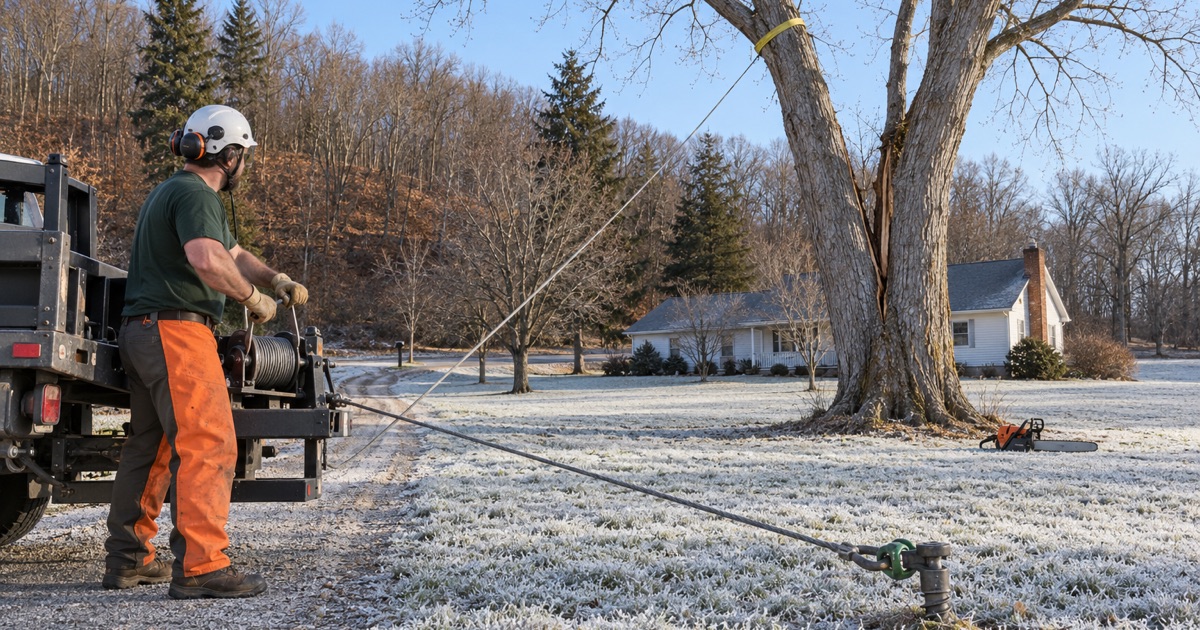
A hard freeze loads that seam from two directions at once. Water standing in the crotch expands as it freezes and pries the seam wider, while the same differential contraction that opens a frost crack pulls at the joint from either side. Put an ice load or a wind gust on top of a union already working itself apart and it does not fail slowly — it blows out, taking half the canopy and whatever is under it.
Cabling, reduction, or removal
Not every included-bark union has to come out. A static or dynamic cabling system in the upper third of the stems shares the load between them, and threaded steel bracing rods through the union address the shear directly where the defect sits low on the trunk. Reducing end weight on the heavier stem shortens the lever and is sometimes enough by itself.
What decides between those and a takedown is how much sound wood remains at the union, what stands under it, and the tree’s condition overall — a union we would cable on a healthy tree in an open field is a different proposition over a bedroom. We write that reasoning down when a customer needs it on paper. Written condition and risk documentation for a boundary letter or an insurance claim is priced as its own deliverable, not folded into a sales visit, because it is different work for a different reader.
Working here: who signs off, and where the wood goes
New Market is unincorporated, so no municipal tree ordinance, landscape rule or city permit reaches a parcel in this community, and the governing body is the Madison County Commission. There is no county zoning ordinance limiting construction projects in unincorporated Madison County, and no county tree removal permit or diameter threshold appears in any county instrument. What the county does enforce is building code — the 2018 International Residential Code with local amendments and the 2018 International Building Code, both effective January 2021 — which matters when a removal is tied to construction rather than to the tree itself.
The service drop is the homeowner’s, and we say so first
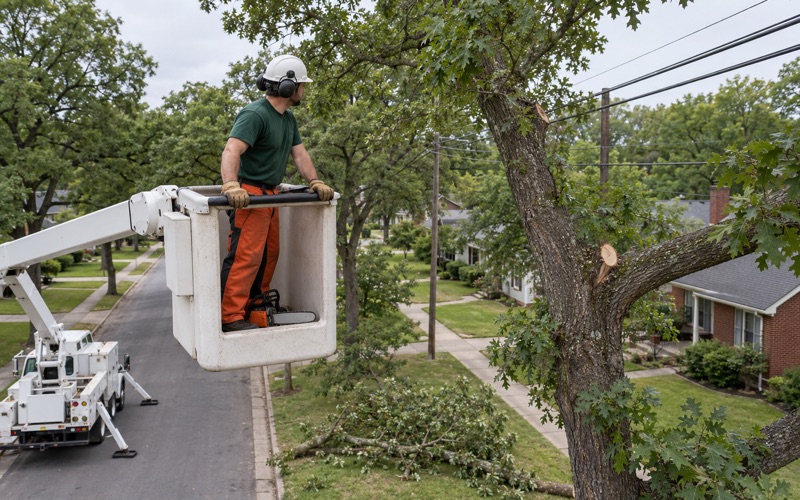
Huntsville Utilities distributes electricity here and performs line clearance on its own distribution lines at no cost to the customer. Its published answer about the wire running pole to house is blunt: the responsibility of clearing trees from customer service wires rests entirely with the customer. We say that at the estimate rather than on the morning of the job, and we arrange the disconnect where the drop is in the way. A tree growing into a distribution line is a call to the utility’s line clearance program instead.
Anything energized and moving — a conductor down after ice, a limb resting on a live line — goes to 911 or the utility’s outage line before it goes to a contractor. The ANSI Z133 safety requirements for arboricultural operations set plain limits on working near energized conductors, and wind and ice do not relax them. We answer storm and hazard calls the same day, and we will tell you on the phone which of those two situations you actually have.
Debris, and why the county will not take yours
Large debris collection out here is administered by the commission district office, which happens to sit in this community rather than downtown. Its published rules state that it does not pick up debris generated by contractors, and tree stumps are named among the items it does not collect. That is not something we let a customer discover on collection day: haul-away is written on the quote either way, and rounds left cut and stacked earn a firewood credit on the same estimate.
One call before the grinder
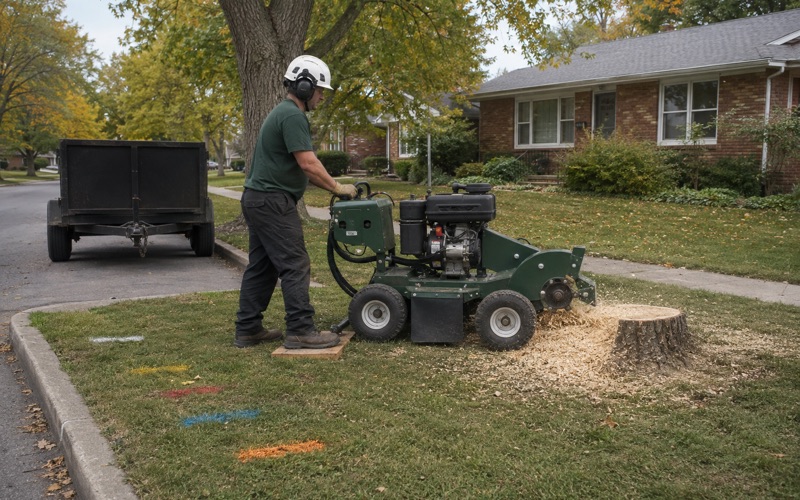
The valley soils here are deep red clays weathered from limestone with a silt loam surface, running well past five feet before they reach rock, so bedrock is not what stops a stump grinder on this ground. Grinding depth below grade becomes a machine-class and pricing decision instead of a geology problem. What can stop a grinder is a buried service run, and Alabama’s one-call statute requires notice of intent to excavate at least two but not more than 10 working days ahead, valid for 20 working days from the proposed start date. Stump grinding is named neither in the statute’s inclusions nor in its exemptions, so we place the call before we grind near a lateral.
- 20+ Years in the Valley
- Free Written Estimates
- Same-Day Storm Calls