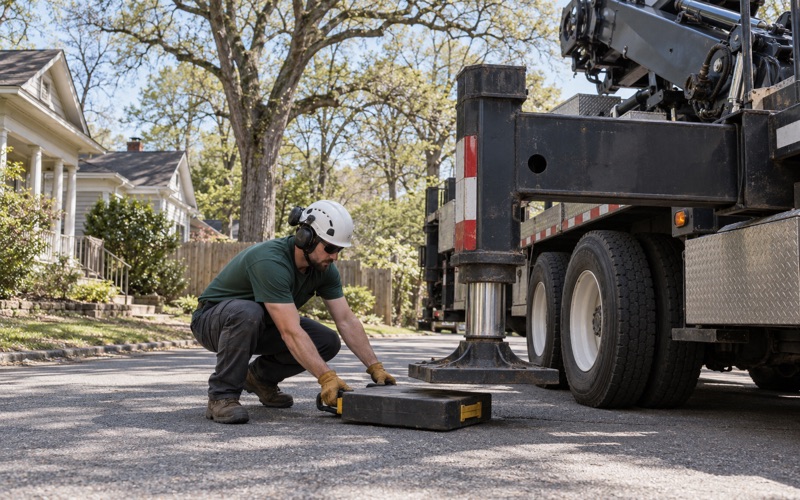
Huntsville Tree Removal Pros has been doing tree removal in Triana for more than twenty years, and no other town we serve opens the conversation the same way. Homeowners here almost always ask a version of the same question before they ask about price: does the Superfund site that carries this town’s name change what happens when a stump comes out of a back yard? It is a fair question and it deserves a real answer rather than a shrug.
The short version is that the record describes a creek system on federal land, the constructed cleanup was finished in 1987, and none of it is a statement about residential yard soil in town. What we actually check before a machine opens ground here has nothing to do with 1970s pesticide manufacturing and everything to do with what is buried two feet down on your own lot.
The rest of how we work is deliberately plain. Every estimate splits the takedown, the stump and the debris into three separate priced lines, because those are the three numbers competing quotes disagree about, and haul-away is written out in words as included or not included so a cheap bid and an expensive one can be compared honestly.
What the Triana Superfund Site Actually Covers
The EPA record is specific, and the specifics are the reassuring part. The Triana/Tennessee River site, EPA ID 0405546, is an 11-mile reach of Huntsville Spring Branch and Indian Creek, two tributaries of the Tennessee River, and that reach lies entirely within Wheeler National Wildlife Refuge and Redstone Arsenal. The site spans Morgan, Madison and Limestone counties on paper, but the contaminated media are stream sediment, surface water and fish tissue inside that federal footprint. From 1947 to 1970 Olin Corporation ran a pesticide manufacturing facility on the arsenal and discharged wastewater into Huntsville Spring Branch; EPA listed the site on the National Priorities List in 1983.
The remedy was built and finished in 1987
Under the 1983 consent decree, contaminated material was backfilled and buried in the stream channel, a new channel was cut to reroute the stream, and diversion structures were built to keep flow out of the old one. That work was completed in 1987 and isolated approximately 95 percent of the estimated DDT in Reach A, and EPA reports the remedy remains protective. Annual fish monitoring concluded in 2015 after all three monitored species met their performance standards. A seven-year monitoring pause began around October 2019, and fish sampling is expected to resume in April 2027.
What the 1983 settlement paid for
On April 21, 1983 EPA announced that Olin had agreed to clean up the DDT contamination around its former facility and to provide health care for Triana residents. The agreement put 5 million dollars into the Triana Area Medical Fund for primary care and monitoring and 24 million dollars in total toward residents of the affected area, of which 19 million dollars satisfied personal injury claims of more than 1,000 private parties, residents and commercial fishermen among them. More than 1,400 acres of Wheeler National Wildlife Refuge were affected. The elevated DDT levels found in residents’ blood came primarily from eating fish out of that water, which is the exposure route the record actually describes.
Looking for tree-removal closer to Harvest? See Tree-Removal in Harvest.
What We Confirm Before a Grinder Opens Ground
Access to the contaminated reach is highly restricted; only the downstream portion of Reach C permits fishing, and a no-restriction advisory was issued for the accessible areas on the basis of 2018 sampling. Nothing in that record says anything about the dirt in a Triana front yard, and we will not let a crew imply otherwise in order to sell a service. The uncertainty on a residential lot here is the ordinary one: what is buried under the stump.
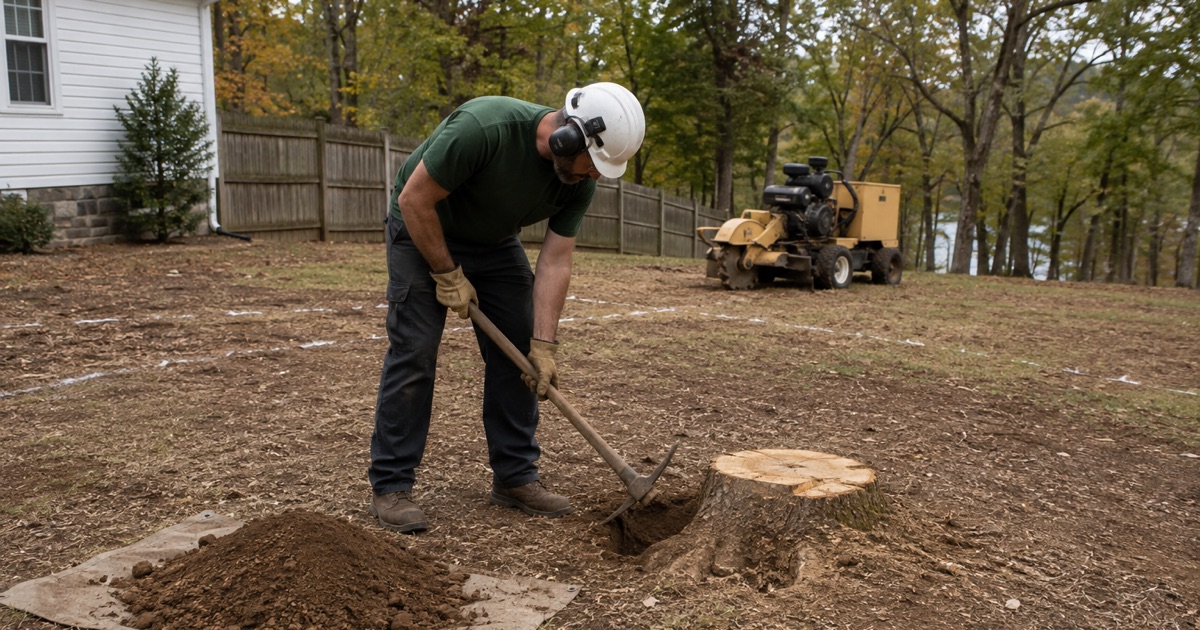
Homeowners occasionally ask whether the soil a grind brings up has to be tested or hauled off as something special before it can be raked back into the lawn. Nothing in the EPA record for this site supports that, and we are not going to manufacture a reason to charge for it. What comes up is wood chips and the top foot or so of your own yard.
The locate request is not optional, and it reaches stump work
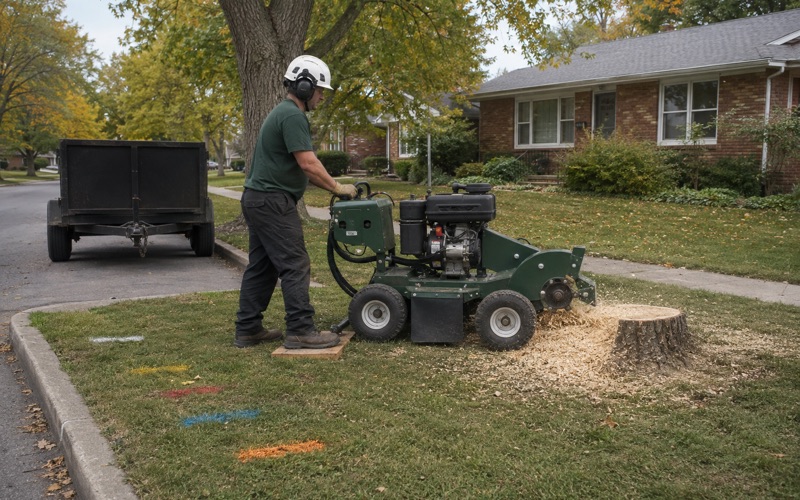
Alabama 811 takes the mandatory locate request before excavation, and that requirement covers stump grinding and root excavation, not only footings and post holes. We file the request and wait out the response window on every grind, including the ones that look obviously clear, because a cutting wheel loaded with carbide teeth does not care what it finds. Grinding depth below grade is then set by what you intend to do with the hole, whether that is sod, a replacement tree or a patio footing, rather than left to whatever the operator feels like on the day.
Private lines are yours to point out
The locate marks member utilities up to the meter and stops there. Irrigation zones, low-voltage lighting, invisible fence, septic laterals and a line run out to a shop are all private, so we walk the yard with the homeowner before the machine comes off the trailer. The Town of Triana operates its own water and sewer systems and maintains its own streets, while Huntsville Utilities supplies electric and natural gas here, so knowing which system a buried line belongs to decides who we call.
When we would rather not guess
Where a stump sits directly over something that cannot be hit, an air-excavation device blows the soil off the root flare and the top of the root plate without cutting anything, so the grinder works against a picture instead of an assumption. It costs an hour and it has saved several. The same tool is how we expose girdling roots when the open question is whether a tree has to come out at all.
Working a Lot That Backs Onto Federal Land
Wheeler National Wildlife Refuge was established on July 7, 1938 and covers 34,430.66 acres across Morgan, Limestone and Madison counties, roughly 19,000 of them land and 16,000 water. Its woods run to bottomland hardwood, riparian and pine upland, with red and white oaks, hickories, poplar, ash and tupelo as the main species. Redstone Arsenal is the other federal neighbor, and access and ground disturbance on arsenal land are federal matters that no municipal or county permit reaches.
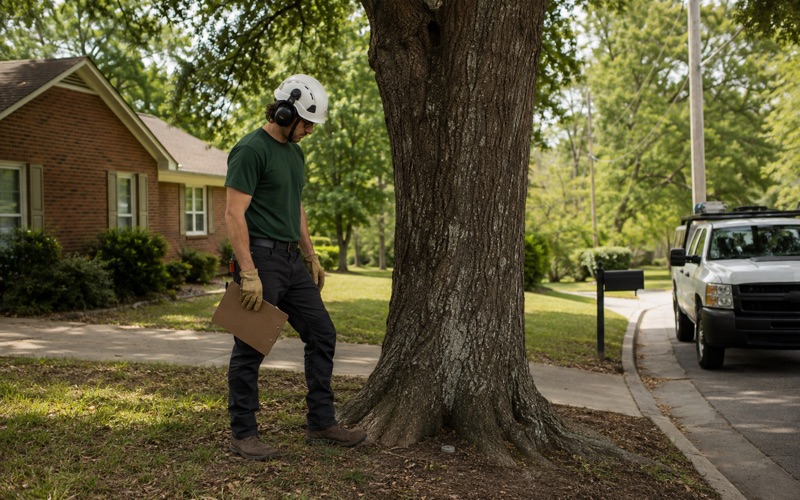
The practical consequence is that our authority stops at your property line, and we say so before anyone climbs. A leaning tree rooted on refuge or arsenal ground is not ours to cut, whatever it happens to be aimed at. What we can do is document it in writing, with species, defect, target and the direction of the lean, in a form you can hand to the managing agency or to your insurer. That condition and risk documentation is priced as its own deliverable instead of being folded into a sales visit.
Access decides the price before the tree does
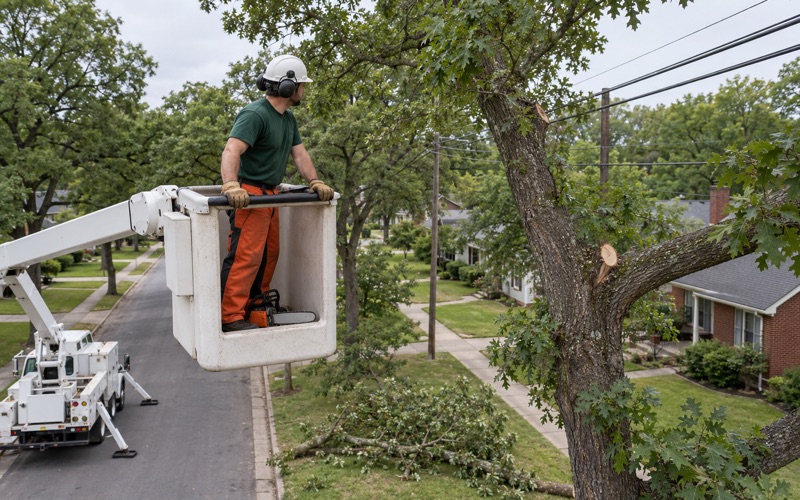
On the parcels nearest the refuge line the constraint is usually not the tree, it is the route to it. We measure gate width, carry distance to the truck and the real drop zone before quoting, and we work out where a chipper that will never fit through a gate is going to sit. When there is no drop zone at all the tree comes down in sections on a bull rope through a rigging block with a Port-a-Wrap at the base, and where a fenced back yard defeats a bucket truck, a tracked lift gets in instead.
Over-roof work is its own decision. Where a stem stands directly above a roofline we would rather set a crane or a tracked lift and pick the pieces clear than rig them down past the shingles, and the estimate names the method we intend to use. A quote that does not say how the tree is coming down is not a quote you can compare against another one.
The span from the pole to your house
Huntsville Utilities holds the distribution right of way, and its published position is that clearing trees off the customer service wire, meaning the span from the pole to the house, rests entirely with the customer. We say that up front, arrange the disconnect, and point you at Line Clearance at 256-535-1224 when the work is genuinely theirs. Storm and hazard calls get answered the same day, and we state plainly where the ANSI Z133 safety requirements stop us from working near energized conductors in high wind or ice.
Where the Wood and the Grindings Go
Triana routes household garbage and large-item pickup to Madison County Waste Control and Recycling, and the county’s rules are the part homeowners find out about too late. The county does not pick up debris generated by contractors; a resident who hires someone for yard work is told the contractor is responsible for removing it from the property. Tree stumps are named first among the items the county does not collect at all, green-waste limbs have to be under 8 feet in length, and where a load exceeds a standard pickup bed a service charge of 50 dollars plus disposal fees is assessed.
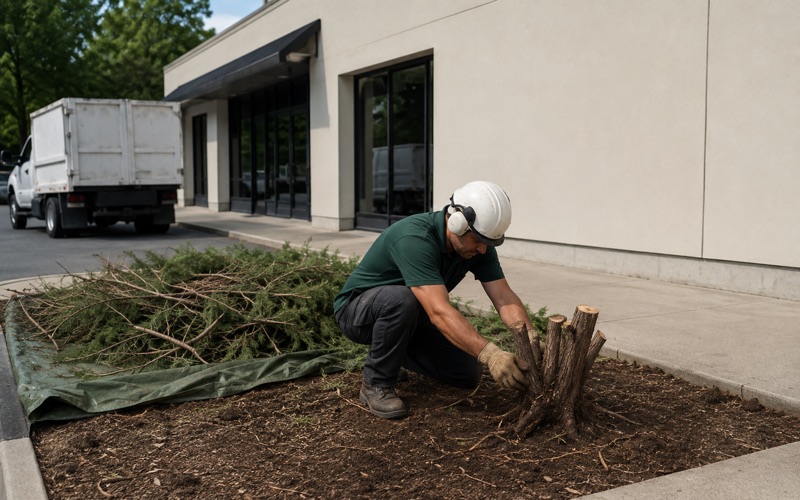
That is why haul-away is a written line on our estimate rather than an assumption. If we are taking the wood it says so, and if we are leaving it the estimate says that too, in words, with what stays behind described. Rounds cut and stacked for firewood earn a credit that shows on the same sheet, and when the carry to the truck is short enough to be worth it, taking the wood away shows up as a credit as well.
Ash carries its own disposal answer
The Alabama Forestry Commission confirmed emerald ash borer in Madison and Jackson counties on June 6, 2025, the first confirmed observation in either county, after earlier documentation in Etowah, Calhoun, St. Clair, Talladega and Shelby counties. The commission’s guidance is that infested ash trees which are cut down should preferably be burned or destroyed on site to slow the insect’s dispersal, and it directs landowners to their county forester or the local commission office. With ash among the main species in the woods on this side of the county, that guidance and the county’s refusal of contractor debris point the same way: an ash removal needs its disposal settled before the first cut.
Grindings, and what fills the hole
A stump grinder leaves a volume of chips and soil noticeably larger than the stump looked. You can keep the pile as backfill, which settles over a season and needs topping up, or we can pull it out and bring in clean fill, and that gets decided on the estimate rather than on collection day. Two things determine whether the debris leaves the same day: whether a knuckleboom grapple truck can reach the pile without crossing a septic field or soft ground, and whether the load is one trip or three. We settle both while we are measuring access, so the number on the estimate is the number on the invoice.
- 20+ Years in the Valley
- Free Written Estimates
- Same-Day Storm Calls